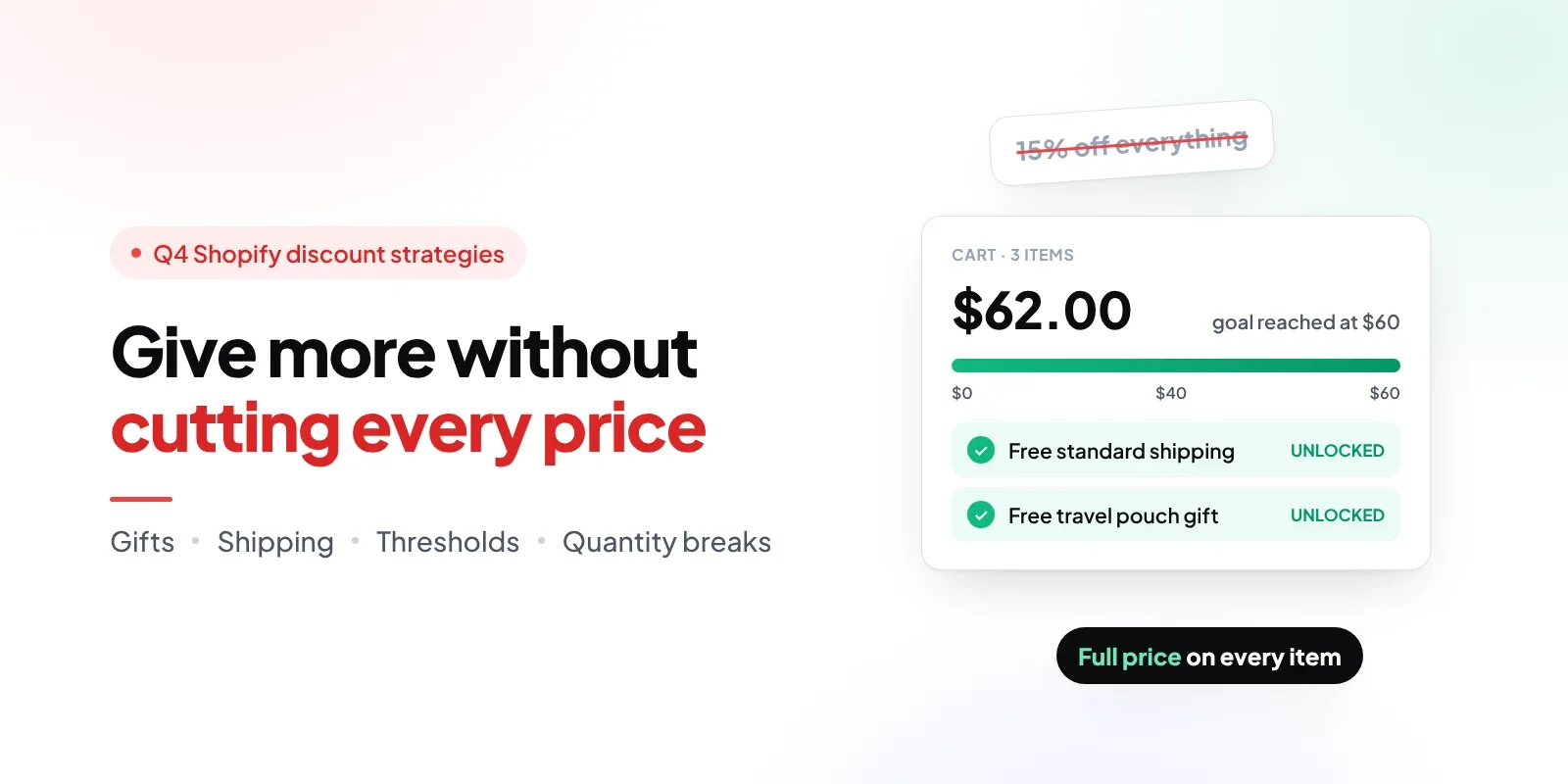
It’s December. Your best-selling gift set is moving at full price, but shoppers buying a single item often leave when they see the delivery charge. A 15% sitewide sale would reduce the price of the gift sets that are already selling. It might also leave the delivery charge that stopped the single-item shopper right where it was.
A free standard shipping offer on eligible carts gives you a way to address that specific problem. In another store, a small gift might make a purchase feel more complete. And for a shopper buying gifts for four people, a quantity break could make buying everything from you easier.
The best Shopify discount strategies start with the part of the purchase you want to change. Then you choose a reward you can afford and decide which carts or customers should receive it. That’s the offer-design step in a Q4-to-Q1 holiday customer retention plan, and it’s what the seven offers below help you do.
Quick answer: Shopify merchants can give holiday shoppers more value through gifts with purchase, free standard shipping, minimum-spend rewards, milestone offers, quantity breaks, customer-specific promotions, and next-order rewards. Choose one based on the shopping behavior you want to encourage. Before launch, calculate what a qualifying order leaves after variable costs and test the offer with your active discounts at checkout.
TL;DR
Use a gift when a useful extra makes the purchase more appealing. Budget for the item and any added fulfillment cost.
Use free shipping when delivery cost is the obstacle. Calculate the shipping charge you’ll give up and check expensive destinations.
Use a minimum-spend reward for one attainable cart target, or milestones when several cart sizes can support different rewards.
Use quantity breaks when shoppers have a reason to buy multiples, such as gifting to several people or stocking up.
Use customer-specific and next-order offers when eligibility or timing matters more than the size of the discount.
Compare contribution profit on realistic carts and measure campaign results alongside order value and redemptions.
Which Shopify discount strategy fits your Q4 offer?
What you want the shopper to do | Offer to try | What to check first |
|---|---|---|
Choose a holiday gift with a useful extra | Gift with purchase | Gift stock and cost per packed order |
Complete a purchase after seeing the delivery charge | Free standard shipping | Shipping revenue forgone and high-cost destinations |
Add one useful item | Minimum-spend reward | How many carts already qualify |
Build a larger basket in stages | Milestone offer | Total cost of the highest reward combination |
Buy several units for gifting or stocking up | Quantity break | Contribution at each tier boundary |
Return after a period of inactivity | Customer-specific offer | Eligibility and purchase behavior without the offer |
Place a second order after the holidays | Next-order reward | Timing, redemption cost, and second-order contribution |
1. Give a useful gift with purchase
Think about what the shopper will do with the order when it arrives. A gift pouch can make jewelry easier to give. A travel-size product can give someone a reason to try another item in a skincare range. Choose an extra that makes sense alongside what the customer bought. If you already sell bundles, adding the gift to an existing bundle can raise its value without lowering the bundle price.
The value to the shopper and the cost to you can differ. If a pouch costs $3 and adds $1 in packing time, its direct cost is $4. Include any change in postage, and calculate how many qualifying orders you can support with available stock. If the pouch goes out of stock halfway through a campaign, update the offer wherever shoppers see it. A small gift is also one of the more affordable service recovery offers for late or damaged holiday orders, so keep a little stock aside for December mistakes.
2. Cover standard shipping on eligible orders
A delivery fee is easy to see at checkout, and shoppers notice when it disappears. In Shopify’s 2025 Global Holiday Retail Report, 41% of shoppers said free shipping and returns would earn their loyalty, just behind discounts at 49%. When the delivery charge is the main obstacle, free standard shipping gives shoppers a clear reason to complete the order. Check your shipping costs by destination, parcel size, and service level before choosing the threshold.
Suppose you usually charge $6 for shipping and pay the carrier $8. Waiving the charge gives up $6 in shipping revenue. You still pay the carrier $8. If the offer also encourages a larger parcel, the increase in carrier cost belongs in the calculation too. State which delivery service and destinations qualify, and keep the delivery promise consistent with your holiday cutoff.
3. Set one minimum-spend reward within reach
A threshold works best when the shopper has a sensible way to reach it. If many carts land around $52 and you sell a useful $8 add-on, test a $60 threshold. Review the distribution of recent cart values to see how many shoppers already clear $60 and how many are close enough to reach it.
Minimums tend to go with bigger orders. Seguno’s 2026 benchmark of 6,099 discount sets from 1,348 brands found that amount-off codes with a minimum purchase averaged $100.79 per order, against $39.30 for codes without one. That’s a comparison across different brands and offers, not proof that the minimum caused the lift, so test your own threshold.
Try the math on two sample carts. Suppose a $52 cart has $22 in product costs and $8 in other variable costs, leaving $22 in contribution profit. A shopper adds an $8 item that costs you $3. If variable costs stay the same and you give $4 off the resulting $60 cart, you keep $23. The larger order earns $1 more. If the shopper already planned to spend $60, the offer costs you $4 on a cart that already qualified. Both outcomes matter when you measure the campaign.
4. Give larger baskets a reason to reach the next milestone
A single threshold works when you want one clear action. Milestones suit stores that already serve different basket sizes. A home goods shop might offer free standard shipping at $75 and a gift at $110. The first reward suits a shopper buying one main gift and a small add-on. The second gives someone buying for several people another reason to complete the order with you.
Decide what the shopper receives at the higher threshold and make that clear wherever you show the offer. Test what happens if they remove an item after qualifying, because milestone discounts on Shopify only stay fair when the reward drops away with the cart total. If the checkout grants both shipping and the gift, calculate both costs together, including any other discount the cart can use.
5. Use quantity breaks where buying multiples makes sense
Quantity breaks give shoppers a reason to buy an extra unit. They fit holiday candles, party favors, giftable accessories, and other products customers may need in multiples. Start with a threshold that makes sense for the way people use the product.
Say one candle sells for $20 and shoppers who buy three pay $18 each. Two candles bring in $40 and three bring in $54. The third candle adds $14 in merchandise revenue because the first two candles also receive the lower price. Subtract the third candle’s product cost and any extra packing, shipping, or payment costs from that $14. Run the same calculation at each tier boundary, especially when crossing the threshold reprices every eligible unit.
6. Give a selective offer to customers with a reason to use it
Different shoppers can have different reasons to come back. A customer who regularly replenishes a product might value early access to a seasonal scent. Someone who’s overdue for a reorder might respond to free shipping on a qualifying cart. Define the group and the action before deciding how much to spend.
Start with a customer group you can explain in one sentence, such as customers who bought from a replenishable range and haven’t ordered in 60 days. Shopify’s customer segment filters include products purchased and last order date, so you can build that group in the admin and tag it. Test the rule with an eligible and an ineligible shopper. A one-sentence group like this is often all a store needs, and it’s the main difference between a loyalty program and targeted offers after BFCM.
If possible, compare repeat purchases against a similar group that receives no offer. A holdout group is the simplest way of measuring incremental revenue from a retention offer, because it shows whether the campaign generated more orders or mainly rewarded customers who were already about to buy.
7. Save a reward for the second order
A holiday order can happen at full price and still give you a chance to encourage another purchase. For example, a stationery store could send a January free-shipping offer to buyers of a refillable planner. The timing works if the follow-up gives them something useful to buy, such as inserts or accessories.
Match the follow-up to what you know about the order. Someone who sent a planner as a gift may have little reason to buy refills. When you know a customer bought a gift, try a follow-up that makes sense for the buyer, such as help finding a gift for the next occasion. Set an expiry that fits the buying window and check what the second order earns after the reward.
How to set up and test your offer in Shopify
Start by writing the offer as a customer-facing sentence. For example, “Get a free travel pouch when you spend $60 on eligible products.” Then record which products count toward the threshold, what stock you have available, and which other promotions customers can use on the same cart.
Shopify covers several of these offers without an app. A free shipping discount can be automatic or a code, with a minimum purchase amount or item count, selected countries, and eligibility for specific customers or segments. A Buy X Get Y discount can make a gift free once the cart reaches a set amount, although the shopper has to add the gift to the cart themselves. Shopify’s built-in volume pricing is part of its B2B catalogs, so tiered quantity breaks for regular retail shoppers usually take several separate discounts or an app.
An app helps when you want several reward tiers in one offer, a gift and free shipping from the same threshold, or quantity tiers across a collection. In DiscountRay, Milestone Offer attaches rewards to order-value or item-quantity thresholds, Quantity Discount sets quantity-based price tiers, and Personalized Discount limits an offer to a customer, a customer tag or list, or cart conditions. According to DiscountRay’s FAQ on how its discounts behave, bundle, personalized, and milestone offers can all give a free gift or free shipping as the reward. Choose the builder based on the eligibility and reward your campaign needs, and check which plan includes the reward you want.
Before announcing the offer, run these checks in checkout.
Test a cart just below the threshold, exactly at it, and just above it. Remove an item and confirm the reward updates.
Test customer eligibility, eligible and excluded products, and any destination or delivery-service restrictions that apply.
Add the automatic discount or code most likely to overlap with the promotion. Shopify only combines discounts when each discount’s settings allow the other’s class, so confirm the savings the shopper actually sees and calculate contribution on that order.
Compare the results with your baseline. Track order value and contribution profit for basket-building offers. For next-order or win-back campaigns, track repeat purchase rate and contribution over the same follow-up window.
Choose your Shopify discount strategy one purchase decision at a time
Look at the next Q4 promotion on your calendar. Pick one thing you want a shopper to do, whether that’s adding a gift, ordering multiples, or coming back in January. The Shopify discount strategies that protect margin are the ones that change that single decision, so cost the reward on a cart you’d actually ship, then test the conditions before the offer goes live. If the promotion works, you’ll know which benefit earned its place in the campaign.
How can I run a Shopify promotion without discounting every product?
My customers only buy when I run a sale. What should I do?
Do discounts create new sales or just move purchases earlier?
Is free shipping cheaper than a free gift?
How do I calculate a free shipping threshold?
How do I choose a minimum spend for a Shopify discount?
Can Shopify automatically add a free gift to the cart when a customer spends over a set amount?
Can I offer a free gift over $100 and keep free shipping over $60?
How do I set up tiered quantity discounts without an app?
How do I stop a discount code from applying to items already on sale?
Can I combine a holiday reward with another Shopify discount?

Syeda Rehnoma Tanzom
This article is written by Syeda Rehnoma Tanzom, an SEO content writer with 3+ years of experience specializing in eCommerce content. What makes the work here a little different? A close collaboration with support teams to understand what merchants are actually going through, their frustrations, their questions, and their wins. The goal is simple: write content that speaks to real problems, not just search engines. When not buried in keywords and content briefs, you'll find her nose-deep in a good book, binge-watching true crime documentaries or psychological thrillers, and occasionally switching gears with a feel-good rom-com.
Este artículo fue revisado por el Technical Support Team de DiscountRay, que ayuda habitualmente a comerciantes de Shopify a probar la configuración de descuentos, la elegibilidad de clientes, el comportamiento del carrito y los problemas de descuentos en el checkout.