Imagine sending the same "20% OFF EVERYTHING" email to two customers.
One is a VIP who has ordered from your Shopify store 15 times this year. They already trust your products and regularly purchase at full price.
The other bought something eight months ago and hasn't returned since. They might need a convincing reason to give your store another chance.
Should both customers receive exactly the same offer?
Probably not.
That's the problem with blanket Black Friday discounts. You might be giving away more profit than necessary on customers who already love your brand, while offering too little to bring inactive customers back.
Personalized BFCM discounts help you approach this differently. Instead of giving everyone a different percentage off, you match the type of offer to the customer's relationship with your store.
In this guide, we'll look at which offers make sense for VIPs, first-time buyers, returning customers, inactive buyers, and B2B accounts. You'll also learn how to translate those decisions into practical discount conditions using Shopify and DiscountRay.
Short Answer: Which BFCM Discount Should Different Customers Get?
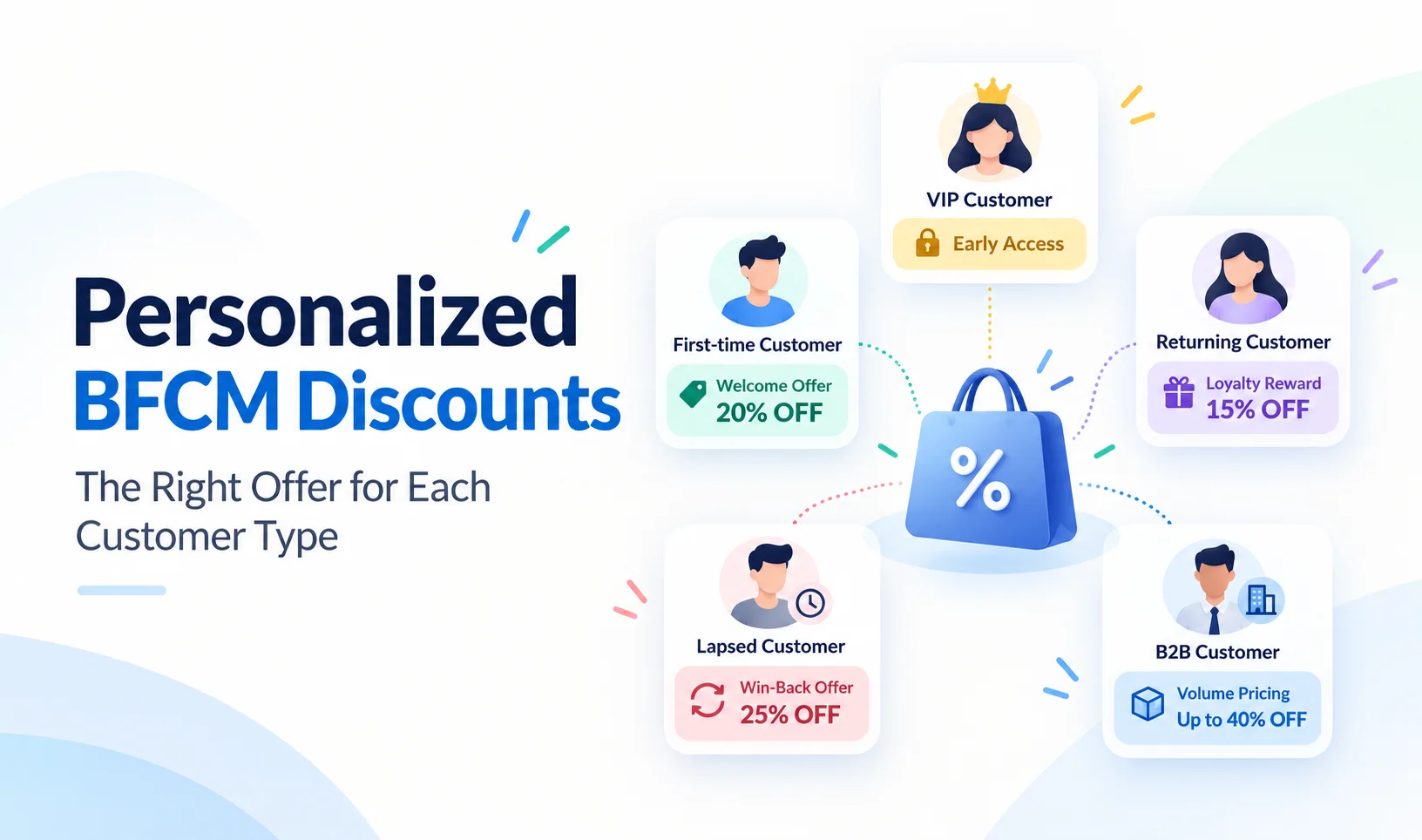
Different customer types should receive offers that match their buying behavior, rather than slightly different versions of the same discount. VIP customers can receive early access, first-time buyers can get an acquisition incentive, returning customers can receive loyalty rewards, and inactive customers may need a stronger win-back offer. B2B buyers generally benefit more from separate volume pricing, while high-cart-value customers can receive threshold-based rewards.
TL;DR
VIP customers: Reward loyalty with early access, exclusive products, or a modest private discount instead of automatically offering the deepest price cut.
First-time customers: Use a compelling introductory offer to encourage a first purchase, with clear limits to protect your margins.
Returning and lapsed customers: Give active repeat buyers loyalty rewards, while reserving stronger win-back incentives for customers who haven't purchased in a meaningful period.
B2B and high-value customers: Use wholesale-specific volume pricing, company-based offers, and cart-value rewards instead of standard consumer promotions.
Avoid discount conflicts: Define segment priorities and combination rules before BFCM so customers receive the intended offer without unexpected stacking.
Why One BFCM Discount Doesn't Work for Every Customer
A sitewide discount is convenient. You create one offer, announce it everywhere, and let customers purchase at the discounted price.
However, convenience doesn't necessarily mean you're using your discount budget effectively.
Think about the different people visiting your store during Black Friday.
Your regular customers already understand your product quality. New visitors might still be comparing your prices with competitors. Meanwhile, a wholesale buyer ordering 100 units has completely different expectations from someone purchasing a single item.
Giving everyone 20% off doesn't account for any of those differences.
The real purpose of BFCM customer segmentation is to understand what each group needs before deciding what to offer them.
For one customer, the deciding factor could be price. For another, it might be free shipping, early access, or the opportunity to purchase more units at a better rate.
With personalized BFCM discounts, you can focus your incentives where they make commercial sense.
It also gives you more control over your margins. You can reserve larger discounts for customers who genuinely need an incentive without automatically reducing prices for everyone else.
This doesn't mean a sitewide sale is always a bad idea. It can still be part of your broader Black Friday marketing strategy. The important decision is whether every customer should also receive the same additional incentive.
VIP Customers: Early Access or a Lighter Incentive
Your VIP customers are the people who consistently support your store. They might purchase frequently, spend more than average, or have an established relationship with your brand.
Naturally, you want to make them feel appreciated during Black Friday.
But giving them your biggest discount isn't necessarily the best way to do that.
Consider offering VIP customers early access to your BFCM promotions instead.
For example, if your public Black Friday sale starts on Friday, eligible VIP customers could receive their private promotional offer on Thursday.
They get the opportunity to shop before the main promotional period, which can be especially appealing when popular products have limited inventory.
You could also consider exclusive product offers or a smaller additional discount on selected items.
The goal is to reward the relationship rather than compete entirely on price.
How to identify VIP customers
You can define VIP status using criteria such as:
Customers who have placed at least five orders.
Customers whose total spending exceeds a threshold you choose.
Customers you've manually assigned to a VIP group.
These are illustrative criteria. Your VIP definition should reflect your products, average order value, and purchase frequency.
Shopify customer segments can help identify qualifying customers based on their order history or spending.
If you're using DiscountRay, you can target customers with an existing VIP tag. Its Growth plan supports customer-tag targeting, while the Pro plan supports more advanced combinations.
For example, you could make a discount eligible only when the customer has the VIP tag and their cart reaches a certain value.
That combined condition requires the Pro rules engine.
The process of building a discount around customer tags and eligibility conditions can help you put that decision into practice.
One important distinction: offering a VIP-only discount does not automatically restrict access to your storefront or prevent other customers from purchasing the products. If you want an actual members-only shopping experience, you must configure access separately.
First-Time Customers: An Acquisition Offer
Now consider someone visiting your Shopify store for the first time.
They may have discovered your products through a Black Friday advertisement or social media campaign. They don't know your brand well yet, and they're probably comparing several options before purchasing.
This is where an acquisition offer can make sense.
Unlike a VIP reward, its purpose is to encourage someone to make their first purchase.
For example, you could offer an introductory discount on selected products or free shipping when a first-time buyer reaches a minimum order amount.
You might decide that a 15% introductory offer works for your store. That's only an illustrative rate, not a general recommendation. The appropriate discount depends on your product margins and customer acquisition costs.
Try to avoid making your introductory offer so aggressive that buyers expect an equally large discount every time they return.
Instead, give them a good reason to try your products, then let your product quality and customer experience encourage their next purchase.
How to identify first-time customers
Shopify supports customer segmentation using order-count information, including the number_of_orders = 0 condition for customer profiles without previous orders.
You can use those segments when configuring eligible Shopify discounts.
However, there is an important limitation. Someone with no identifiable customer profile may not be recognized as belonging to your intended segment when they reach checkout.
Test first-purchase eligibility with actual new-customer checkout scenarios before launching.
For a simple acquisition campaign, Shopify's native discount settings may be sufficient. More advanced campaigns can use order-history conditions available in DiscountRay's Pro plan, depending on the eligibility logic you need.
Returning Customers: A Loyalty Offer, Not a Discount Race
Returning customers are people who have purchased from your store before and continue to engage with your brand.
They're valuable, but not every returning customer qualifies as a VIP.
For example, someone who purchased twice this year may be a regular customer, while someone who has placed 20 orders and consistently spends more might belong in your VIP segment.
That difference matters when designing Shopify Black Friday personalized offers.
You want returning customers to feel recognized without making every repeat purchase dependent on a substantial price reduction.
A loyalty-style offer can be a better fit.
You might offer a modest discount on selected products, free shipping after a reasonable minimum spend, or a free gift with a qualifying order.
Imagine a skincare store with customers who regularly repurchase cleansers and moisturizers.
Rather than discounting its entire catalog, the store could offer returning customers a small reward when they purchase their usual skincare essentials together.
This gives customers something relevant without making the entire purchase dependent on a deep discount.
How to identify returning customers
In Shopify, you can create a customer segment based on previous purchases using the number-of-orders filter.
For DiscountRay, merchants using customer tags can target an established returning-customer group.
The Pro plan also supports order-history conditions, allowing more detailed eligibility rules.
Just make sure your VIP and returning-customer definitions don't accidentally create conflicting offers.
Lapsed Customers: A Stronger Win-Back Incentive
What about customers who purchased from you previously but haven't returned?
These customers need a different approach.
They already have some experience with your store, but something has changed. Maybe they found another brand, their needs changed, or they simply haven't had a reason to purchase again.
A general Black Friday announcement might not be enough to bring them back.
This is where a stronger win-back offer may be worth testing.
For example, you could create a private BFCM campaign offering a larger discount on selected products, a fixed amount off a qualifying order, or an incentive tied to returning for another purchase.
But before creating the offer, you need to define what "lapsed" means for your business.
How to identify lapsed customers
Suppose you run a skincare store where customers typically reorder every two or three months.
Someone who hasn't purchased in 180 days might reasonably be considered inactive.
For a furniture business, however, a six-month gap could be completely normal.
So your definition should reflect your typical buying cycle.
For illustration, a Shopify segment for customers who have purchased before but not within the past 180 days could use:
number_of_orders > 0 AND last_order_date <= -180d
Shopify supports order-count and last-order-date filters for customer segmentation.
Once you've identified that audience, you can create an exclusive offer for them.
DiscountRay's Pro plan supports order-history targeting. Alternatively, you can use a previously assigned customer tag with Growth-level targeting.
Don't automatically assume every customer who purchased six months ago needs a bigger discount. If they're already likely to return, you may be giving away margin unnecessarily.
You should also consider excluding lapsed customers from your ordinary returning-customer promotion when you want the win-back offer to take priority.
Your objective isn't simply to generate another discounted order. It's to make reactivating the customer worthwhile for your business.
B2B Customers: Separate Volume Pricing
If you sell to both retail and wholesale customers, this is one segment you shouldn't overlook during BFCM.
B2B buyers often operate with different purchasing requirements.
A retail customer might buy two candles as holiday gifts. A wholesale customer might purchase 120 candles for resale.
Offering both customers a standard 20% discount ignores the difference in how they purchase.
Wholesale buyers often care about unit costs, quantity breaks, and whether an order is commercially worthwhile.
That's why volume-based pricing can make more sense than a general consumer Black Friday discount.
Offer quantity-based incentives instead of blanket discounts
Imagine you're selling packaging materials to retailers.
Your normal wholesale pricing already accounts for larger orders.
For BFCM, you could introduce an additional, limited-time quantity incentive on selected products.
For example, you might offer one price break at 50 units and another at 100 units.
These quantities are illustrative. The actual thresholds should reflect your product margins, inventory, and existing wholesale agreements.
The benefit is that your promotion encourages a purchasing behavior that makes sense for your business: ordering in greater volume.
You also avoid giving the same promotional treatment to someone purchasing one unit.
Identify B2B buyers by company, not just a customer tag
You can identify wholesale buyers using customer tags, but tags and actual B2B company records are not the same thing.
A tag such as Wholesale identifies a customer group you've defined.
A B2B company condition allows you to create an offer around a specific company relationship.
This matters when different businesses have different negotiated prices, purchasing volumes, or promotional agreements.
DiscountRay's Pro plan supports targeting B2B companies, including combining a company condition with cart-value, cart-item, or other supported conditions.
For instance, a merchant could configure a promotion that applies when:
The buyer belongs to an eligible B2B company.
The cart meets the required purchase threshold.
The order qualifies for the selected promotional reward.
This allows you to manage a conditional BFCM offer rather than applying the same consumer incentive across retail and wholesale orders.
For more context, structuring B2B pricing around company relationships and purchasing conditions helps clarify when to use personalized promotional discounts.
What if you're already using Shopify B2B catalogs?
You may not need a separate discount app for every wholesale pricing requirement.
Shopify's native B2B catalogs support product pricing and volume pricing, subject to your Shopify plan's available features.
If you need ongoing negotiated wholesale prices, catalogs are often the more appropriate starting point.
If you want a temporary BFCM promotion on top of existing pricing, you can consider Shopify's native B2B discount eligibility or a conditional discount app.
Be especially careful with catalog prices. Shopify notes that eligible discounts can apply on top of catalog price adjustments.
That means an additional holiday offer may reduce an already discounted wholesale price further than you intended.
High-Value and Market-Specific Segments: Exclusive and Localized Offers
Not every useful customer segment is based on previous purchases.
Sometimes, the current cart or the customer's market gives you enough information to design a more relevant offer.
High-cart-value customers
Imagine two customers shopping during Black Friday.
One has $40 worth of products in their cart.
The other has $250 worth of products.
Should they automatically receive the same incentive?
Not necessarily.
A cart-value reward can encourage customers who are already close to a meaningful spending threshold.
For example, you might offer a free gift or a fixed discount when an eligible order reaches $200.
This is a hypothetical threshold, not a recommended amount.
The key is to choose a reward that makes sense after accounting for product costs, shipping expenses, and expected profit.
Also, don't confuse a high-cart-value customer with a VIP.
A first-time buyer placing a large order isn't automatically a loyal customer. They're simply making a high-value purchase.
For that reason, cart-value incentives can work as their own promotional category.
Market-specific customers
If you sell internationally, customers in different markets may have different purchasing expectations and shipping costs.
For example, free shipping might be affordable for domestic orders but too expensive for smaller international purchases.
Instead of offering it everywhere, you could create a country-specific incentive with a cart-value requirement.
DiscountRay's Pro plan supports country, currency, and cart-value conditions, including combinations using AND/OR logic.
Shopify also supports discount eligibility by market, which may be sufficient for simpler campaigns.
Before setting these up, spend some time organizing your customer groups around purchasing behavior and market differences.
One rule is particularly important: customer location and purchase currency are different conditions. Don't assume that targeting one automatically restricts the other.
Personalized BFCM Discounts: Which Offer Fits Each Segment?
Here's a practical comparison you can use while planning your BFCM campaign.
Customer segment | Recommended offer | Possible eligibility condition |
|---|---|---|
VIP customers | Early access or exclusive reward | VIP customer tag or segment |
First-time customers | Introductory purchase incentive | Eligible customers with no previous orders |
Returning customers | Loyalty reward or selected-product offer | Returning-customer tag or order history |
Lapsed customers | Stronger win-back incentive | Last-order-date segment or supported order-history condition |
B2B customers | Company-specific offer or volume pricing | B2B company and purchasing conditions |
High-cart-value customers | Free gift or threshold reward | Total cart value |
Market-specific customers | Localized discount or shipping reward | Country, currency, or eligible market |
The conditions shown are possible ways to identify audiences, not a claim that every condition is available in every DiscountRay plan.
A useful starting point is to build three or four segments that are meaningfully different, rather than creating a separate offer for every small customer variation.
What Happens When a Customer Qualifies for Two Segments?
Let's say one of your VIP customers also has $300 worth of products in their cart.
You've created a VIP discount and a separate reward for customers whose carts exceed $200.
Which offer should they receive?
Now imagine a previously loyal customer who hasn't purchased for eight months. They qualify as both VIP and lapsed.
These situations are common when you use multiple customer conditions.
And if you don't plan for them, your BFCM campaign can produce unexpected results.
There are two separate problems to solve.
The first is customer eligibility.
You need to decide which customer group takes priority.
For example, you might choose to prioritize B2B company promotions over consumer offers, while letting eligible lapsed customers receive the win-back campaign instead of the standard returning-customer reward.
The second is discount combination.
Shopify allows eligible product, order, and shipping discounts to combine, but the result depends on the discount classes, combination settings, and other applicable limitations.
Simply qualifying for two promotions doesn't guarantee that both will apply.
Before launch, establish your own rules for situations such as:
VIP plus high-cart-value eligibility.
Lapsed customer plus returning-customer eligibility.
B2B company plus a public sitewide discount.
Country-specific reward plus another shipping offer.
For combinations you don't intend to allow, configure your eligibility and combination settings accordingly.
For eligible combinations you do intend to allow, test the final checkout total rather than assuming Shopify will produce your preferred pricing outcome.
A BFCM discount stacking checklist can be useful for reviewing these conflicts before your campaign goes live.
Building This in DiscountRay (and What's Gated by Plan)
Once you've decided which offer belongs to each segment, the next question is how to implement it.
You don't necessarily need an app for every BFCM discount.
Shopify's built-in discount settings currently support targeting specific customers, customer segments, and eligible markets for both discount codes and automatic discounts.
For a straightforward VIP campaign or a basic first-time-customer offer, that may be all you need.
But if your campaign requires multiple conditions within the same rule, a more advanced setup may be useful.
That's where DiscountRay's personalized discount features fit.
What DiscountRay supports
Its Growth and Pro plans support different levels of customer targeting.
Growth plan
This plan includes targeting specific customers, B2B customers, and customer groups through tags. It also supports promotional scheduling.
For example, you can create a targeted promotion for customers tagged VIP without needing to combine multiple advanced conditions.
Pro plan
The Pro plan includes the personalized discount rules engine and supports combining conditions with AND/OR logic.
Supported targeting options include:
Specific customers, customer lists, and B2B companies.
Country, currency, and domain.
Products, total cart value, and cart items.
Order history.
Multiple conditions within one personalized offer.
It also supports multiple rewards within an eligible personalized offer.
For example, you could configure a rule based on a customer group AND a cart-value threshold, rather than making an offer available to the entire group regardless of their order.
The plan distinction matters. Don't assume that a Growth-level customer-tag discount can automatically use all the advanced conditions available on Pro.
A practical setup process
Start by choosing the customer group you want to target.
Then decide what action or reward fits that group. It might be a percentage discount, fixed discount, free gift, or shipping incentive.
Next, identify the conditions needed to make the offer eligible.
For a VIP campaign, that may be a customer tag. For a B2B promotion, it might involve a specific company and a cart threshold. For an international promotion, it could involve country and cart value.
Once you've created the relevant offer in DiscountRay, review the discount settings and test the intended customer scenarios.
Remember that Shopify customer segments and customer tags are not interchangeable. If your offer targets a tag, confirm that the intended customers actually have that tag.
Don't stop testing when the discount appears. Check that the wrong customer cannot receive it, that excluded products remain excluded, and that combinations produce the expected checkout total.
DiscountRay is one way to build targeted Shopify discounts, but it doesn't replace the need to plan your segment definitions, customer communication, and profit margins.
FAQ: Personalized BFCM Discounts for Shopify
How many customer segments should I run during BFCM?
What's the difference between a VIP offer and a loyalty offer?
Can I combine a segment discount with a sitewide BFCM sale?
Do B2B customers need a separate discount code from retail customers?
How do I know if a customer qualifies for more than one segment?
Conclusion
You don't need to offer your biggest discount to every customer to run an effective Black Friday campaign.
Your VIP customers might appreciate early access. First-time buyers may need an introductory incentive. Returning customers can receive loyalty rewards, while lapsed buyers may respond better to a carefully targeted win-back offer.
And if you sell wholesale, your B2B customers deserve pricing decisions that reflect how they actually purchase.
The best approach to personalized BFCM discounts isn't giving every customer a different percentage off. It's understanding what each customer group needs and choosing an appropriate offer while protecting your margins.
Start with the customer segments you already understand, give each one a clear purpose, and test the conditions before launching your BFCM campaign.

Syeda Rehnoma Tanzom
This article is written by Syeda Rehnoma Tanzom, an SEO content writer with 3+ years of experience specializing in eCommerce content. What makes the work here a little different? A close collaboration with support teams to understand what merchants are actually going through, their frustrations, their questions, and their wins. The goal is simple: write content that speaks to real problems, not just search engines. When not buried in keywords and content briefs, you'll find her nose-deep in a good book, binge-watching true crime documentaries or psychological thrillers, and occasionally switching gears with a feel-good rom-com.
この記事はDiscountRayのテクニカルサポートチームが確認しています。同チームは、割引の設定、対象顧客の条件、カートの挙動、チェックアウト時の割引に関する問題のテストを日常的にShopifyマーチャントと行っています。