
Every semester, schools flood your inbox asking for bulk PLA filament quotes. Every time, you manually adjust prices, send custom invoices, and hope they’ll reorder next term.
What if Shopify could handle all that automatically?
According to Market.us Scoop, the 3D printing market hit $17 billion in 2022. Filament, resin, and other materials already represent a $1.7 billion segment of that.
So if you’re selling PLA spools on Shopify, you’re operating in a multibillion-dollar opportunity. Volume discounts on PLA filament can help you take a bigger slice.
Let’s explore how you can set up automated, transparent bulk pricing for PLA filament spools and attract high-value educational buyers this academic season.
Don’t miss the bonus tip at the end. It’ll make selling easier than ever!
For educators, 3D printing isn’t just a hobby. It’s a hands-on way to teach creativity, design, and engineering. Schools often purchase dozens of filament spools at a time to equip entire classrooms or labs.
Naturally, they expect wholesale-like discounts.
Yet, most Shopify stores sell at flat prices, meaning a customer who buys 1 spool pays the same as someone buying 50. That doesn’t align with how institutional purchasing works.
Educational institutions often reach out asking:
“Can we get a discount if we buy in bulk?”
“Do you have educational pricing?”
If you’ve received messages like that, you’re already seeing a valuable pattern. These buyers want clear, automated volume pricing displayed upfront, without back-and-forth emails.
Merchants selling 3D printing materials, filament, and related supplies often share the same pain points:
This manual process not only slows down your workflow but also discourages repeat orders, especially from schools that need predictability.
Meet MakerSupplyCo, a fictional Shopify store that sells spools in 15 vibrant colors. Every semester, they receive emails from design schools and STEM programs asking for bulk PLA filament pricing:
“We’re ordering 25 spools for our robotics class. Can we get a discount?”
Here’s what their old process looked like:
This worked, but it wasn’t scalable.
By the third semester, the founder realized they were spending hours per week managing educational orders that could easily be automated.
That’s when MakerSupplyCo installed DiscountRay, a Shopify discount app. It automates tiered pricing and volume-based discounts directly on product pages.
Using DiscountRay, MakerSupplyCo created a simple rule for their PLA Filament Spools:
(P.S. This table is just for the 1 kg spool.)
| Quantity Range | Price per Spool | Discount |
| 1–29 spools | $12 | — |
| 30–39 spools | $11.4 | 5% off |
| 40–49 spools | $11.8 | 10% off |
| 50–59 spools | $10.2 | 15% off |
| 60+ spools | $9.6 | 20% off |
Within seconds, the pricing tiers appeared automatically on their Shopify storefront.
Here’s what makes this setup powerful:
So when an educational buyer adds 40 spools to the cart, the system updates prices automatically. No coupon codes, no emails, no hassle.
Volume pricing isn’t just about lowering prices. It’s about creating fairness and value alignment.
Here’s why it works perfectly for B2B or institutional buyers:
For merchants, it’s a double win. You sell more per transaction and reduce operational overhead.
If you’d like to set up the same experience in your own Shopify store, here’s a quick guide:
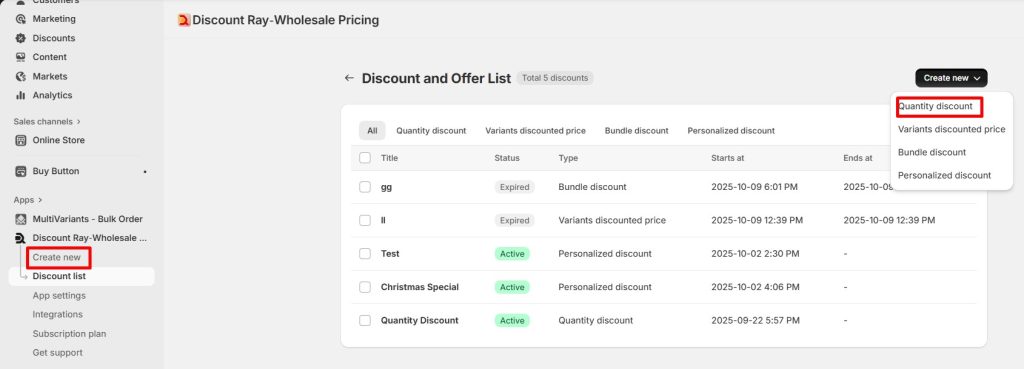
Go to the Shopify App store and install DiscountRay. From the dashboard, click “create new” ➡ “Quantity Discount”. Make sure you added the app embed.
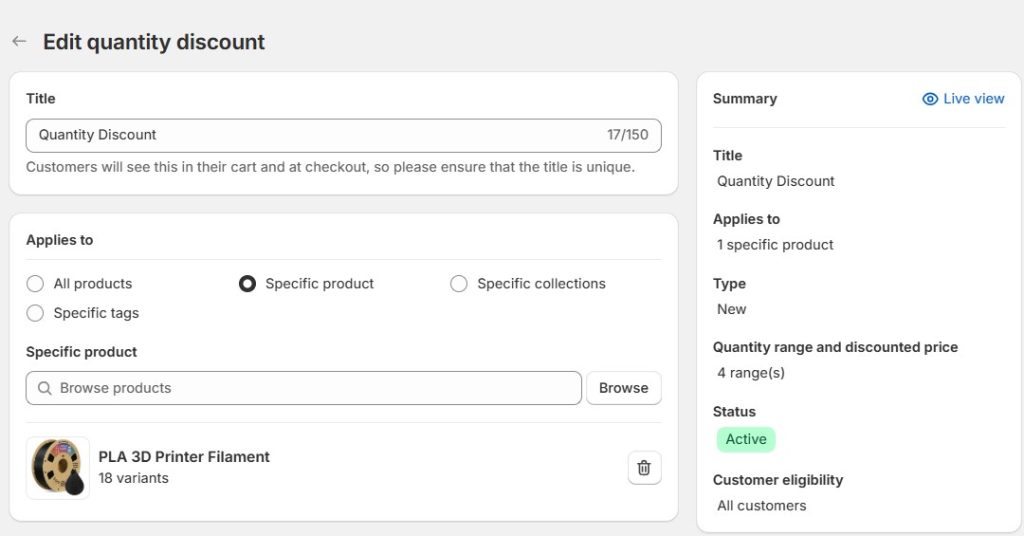
After giving a title, add the products. There are multiple options available. You can apply the discount to all products, any specific product, specific collections, or specific tags.
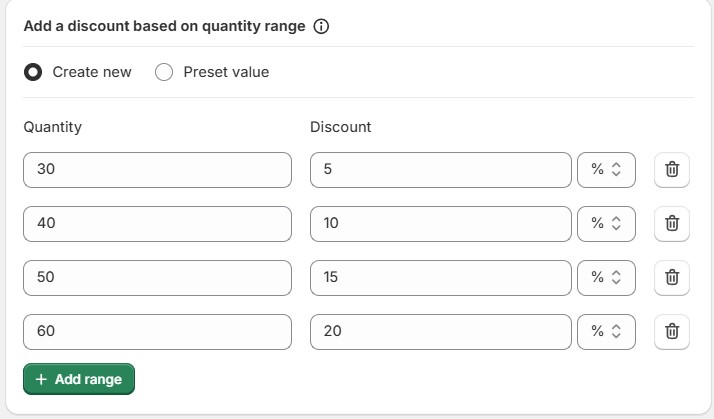
This is what you’re waiting for, right?
Set different discount rates based on quantity ranges. Once you save these ranges, they’ll be stored as a preset. You can easily reuse the same preset values in future campaigns without setting them up from scratch.
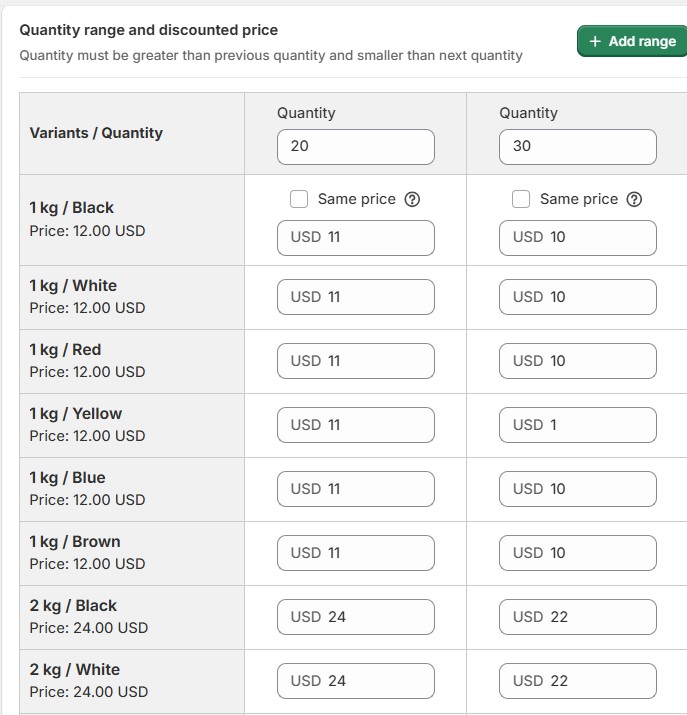
DiscountRay gives you more than just standard volume discounts. You can also set variant-based discounted prices on the same product.
Unlike typical volume discounts (where the same rate applies across all variants), this option lets you customize. For example, you might set a 5% discount on the 1 KG filament, but offer a bigger discount on the 3 KG filament. This encourages buyers to choose the larger variant, boosting both sales volume and average order value.
B2B buyers often need multiple variants in a single order. Jumping back and forth between the cart and product page wastes time. The faster solution is using a bulk order app like MultiVariants with rules applied on the same product page. The integration of DiscountRay with MultiVariants makes it simpler.
For example, you can set a rule like a minimum of 5 units per variant. This ensures buyers must order at least 5 of each variant they choose. This setup works perfectly for B2B.
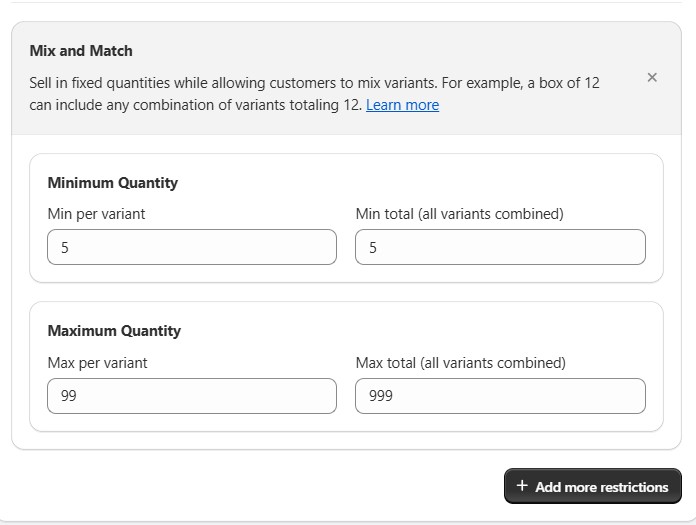
By default, Shopify still shows the regular variant selector, quantity field, and “Add to Cart” button. This can cause issues, since a buyer could still purchase just 1 unit and bypass your rules.
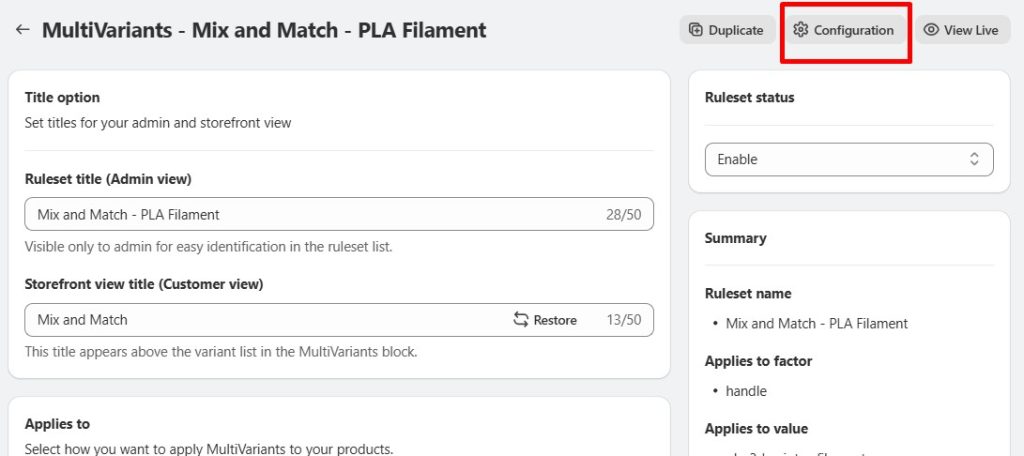
To fix this, go to Configure Settings → Cart & Checkout Buttons, and hide the default Add to Cart. Once that’s hidden, Shopify’s built-in variant and quantity fields disappear automatically. If they don’t, just reach out to the MultiVariants support team. They’re available 24/7 to help.
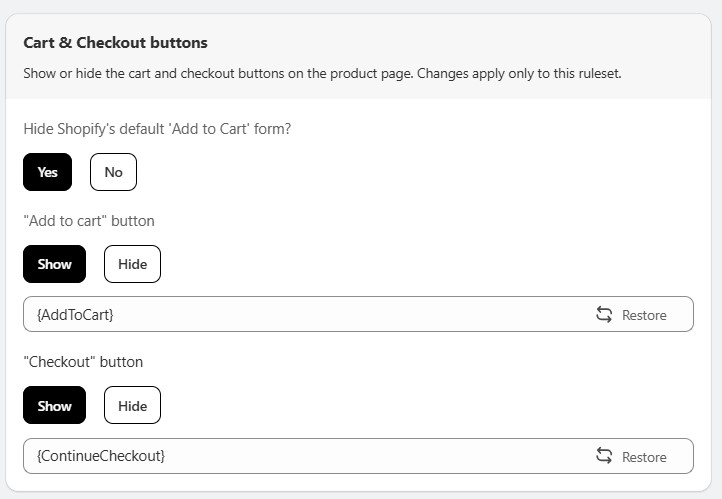
Now, when buyers add multiple spools or variants, the app instantly applies the rules and calculates discounts in real time. That way, customers get a smooth buying experience while you stay in full control of bulk order requirements.
Shopify’s built-in discount tools are great for simple promo codes. However, they weren’t designed for complex, quantity-based B2B pricing.
DiscountRay fills that gap with features built for wholesale, education, and institutional sales, such as:
Instead of maintaining separate Shopify Plus scripts or third-party spreadsheets, merchants can manage everything in one clean dashboard.
This approach not only scales sales but also makes your store look more professional to institutional buyers who expect transparent pricing.
Offering volume discounts on PLA filament is about more than just selling more products. It’s about building trust and convenience for buyers who order repeatedly.
By using DiscountRay, you can:
In just a few clicks, you can turn your Shopify store into a B2B-friendly, education-ready storefront with automated pricing that works 24/7.
You can use apps like DiscountRay to set tiered pricing rules based on quantity. For example, when a school orders 10 or more spools, the app automatically reduces the per-unit price.
Yes, many buyers expect special pricing if they are institutional. You can implement tiered pricing or account-based pricing restrictions.
As a merchant, strategies might include:
• Vacuum-seal every roll
• Offer a small defect tolerance (e.g., refund / replace if < X% fails)
• Provide dryness instructions or include a dessicant pack
• Quality-test a sample batch before shipping
Get started with our free plan or unlock premium features with a 14-day free trial.
30-day money-back guarantee!



 English
  日本語
日本語  Français
  Deutsch
  Español
  简体中文
简体中文  Italiano