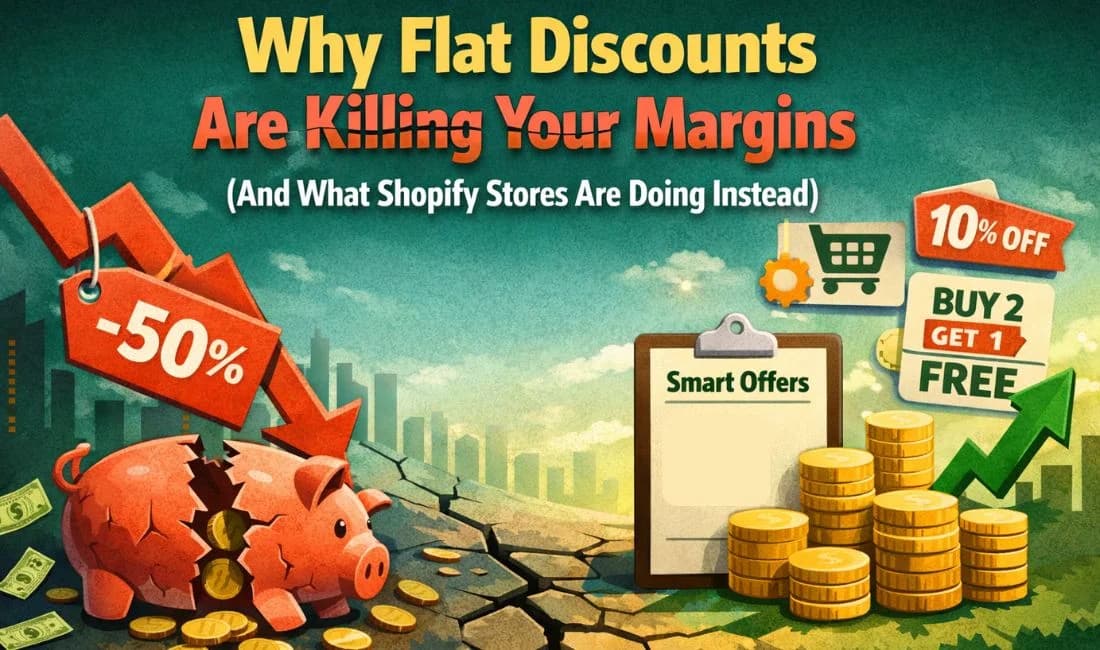
You launch a sitewide sale to boost conversions. Traffic climbs, orders increase, and your revenue graph looks strong for the week. It feels like momentum is back in your favor. Then you check your margins more closely. Best-selling products were discounted even though demand was already high. Repeat customers who were ready to pay full price used the promotion anyway. What looked like growth starts to feel like a trade-off.
This is the hidden cost of the Shopify flat discounts merchants use most often. They apply the same percentage to every product and every buyer, regardless of context or intent.
Flat discounts are killing your margins because broad percentage cuts reduce profit across the board. Smarter stores are shifting toward targeted bundles, tiered pricing, and behavior-based offers that protect margin while still driving sales.
Table of Contents
Before you continue relying on simple percentage sales, it helps to understand how smarter discount systems actually work together. Our main guide on Shopify Default vs Smart Discounts breaks down the full comparison step by step. You can use it to see where standard discounts fall short, understand how behavior-based pricing improves margins, and plan a discount structure that supports long-term growth instead of short-term spikes.
The Hidden Cost Most Merchants Don’t Calculate
Most merchants calculate the obvious cost of a promotion, which is the reduced margin per unit. If you offer 20% off, you immediately see the impact on profit for every product sold. What often goes unmeasured is the invisible cost that builds over time.
Repeated flat discounts quietly reshape a customer’s internal reference price. If shoppers regularly see your products at 20% off, that discounted number becomes the “real” price in their mind. The full price starts to feel inflated rather than standard.
This creates a waiting game. Returning visitors browse, add items to cart, and leave, expecting another sale soon. Research consistently shows that frequent discounting increases price sensitivity and lowers willingness to pay full price over time.
The short-term boost looks attractive. The long-term conditioning is expensive.
Why “Everyone Gets the Same Deal” Is the Core Problem
Shopify Flat discounts treat every customer the same. A loyal wholesale buyer placing large recurring orders receives the exact same percentage off as a first-time visitor who just discovered your brand. A shopper who was already ready to purchase gets rewarded in the same way as someone who needed convincing.
In many cases, you are paying to convert people who did not need converting.
This is where margin leakage accelerates. Instead of using discounts as a strategic tool, they become a blanket policy. High-intent buyers, repeat customers, and even full-price shoppers are trained to expect a deal.
Part of the reason this pattern is so common is that Shopify’s native discount tools make it incredibly easy. You can create a storewide percentage code in minutes. The friction is low, so the habit forms quickly.
The issue is not discounting itself. Strategic incentives can absolutely drive growth. The real problem is undifferentiated discounting, where context, customer type, and buying intent are ignored.
What Shopify’s Default Discount System Actually Lets You Do (And Where It Stops)
Shopify’s native discount system is designed for simplicity and speed. You can create percentage codes, fixed-amount discounts, minimum cart value thresholds, and usage limits within minutes. For many stores, this covers the basics well.
You can also schedule promotions and restrict codes to certain products or collections. From an operational perspective, it works smoothly and is easy to manage.
However, this is where the ceiling appears. There is no true cart-reactive logic that adapts in real time. There are no built-in visual triggers that respond dynamically to customer behavior. There is no native customer-segment pricing or automatic tiering based on quantity.
Shopify was built for accessibility, not deep pricing optimization. That is why many merchants relying on Shopify flat discounts structure eventually look beyond the default tools when margins start tightening.
The Shift: From Blanket Sales to Behavior-Based Triggers
The real shift happening in modern Shopify stores is strategic, not technical. Instead of broadcasting the same discount to everyone, merchants are using incentives that respond to behavior.
Volume or tiered pricing is the simplest example. Buy more, save more. The discount only increases when the order size increases, which protects the margin while encouraging a higher average order value. The math works because the customer earns the deal through quantity.
Cart-based triggers follow the same logic. A discount activates only when the cart meets specific conditions. Casual browsers never see a reduced price unless they qualify.
This approach prevents customers from anchoring to a permanently lower price. It rewards intent, not just presence, and keeps margins healthier while still driving conversions.
Personalization: The Part That Actually Drives Repeat Purchases
Once you have customer data, treating everyone the same becomes a strategic mistake. Purchase history, order frequency, and average order value tell you who your buyers really are. Yet many stores continue using Shopify flat discounts logic, applying identical offers to first-time visitors and long-term customers.
Customer-tag-based pricing changes that are dynamic. A B2B buyer placing wholesale orders can see structured volume pricing. A loyal retail customer might unlock exclusive repeat-purchase incentives. A new visitor may receive a limited first-order offer instead of an aggressive storewide discount.
The difference is subtle but powerful. Personalized pricing signals recognition. It tells customers the store understands their relationship, rather than broadcasting a generic promotion to everyone.
This is where modern Shopify discount strategy 2026 thinking is heading. Not louder sales, but smarter ones. When incentives reflect behavior and history, customers feel valued rather than targeted. And that shift is what turns one-time buyers into repeat purchasers.
What This Actually Looks Like in a Real Store
Imagine a store combining volume tiers, customer tags, and scheduled promotions into one cohesive system.
On the product page, shoppers see a dynamic pricing table that updates in real time as quantity increases. Buy five units, save 10%. Buy ten, save 15%. The savings are visible before checkout, which increases clarity and order size.
Wholesale customers logged into tagged accounts automatically see their specific pricing structure. Retail shoppers see standard tiered incentives instead. No manual code entry is required.
During seasonal campaigns, scheduled promotions activate automatically and display through real-time discount widgets that show exact savings in the cart. Variant-specific pricing ensures only selected products receive special treatment, protecting margins elsewhere.
Shopify discount app makes this possible without custom development. The mechanism is simple: rules react to cart behavior, customer identity, and timing. The result feels intentional, not aggressive.

When a Flat Discount Still Makes Sense
Flat discounts are not inherently bad. In some situations, they are the right tool. Clearing out aging inventory, matching a competitor’s price during a short-term promotion, or offering a one-time welcome incentive can justify the approach. These are tactical moves with a clear purpose and time limit.
The issue begins when that tactic becomes the default setting for every campaign. A strong Shopify discount strategy 2026 mindset treats flat discounts as occasional tools, not permanent pricing policies. Used intentionally, they can support growth. Used automatically, they quietly erode margin.
Conclusion
Every discount should answer one question: what is it designed to achieve?
If the goal is simply to increase short-term revenue, Shopify flat discounts may appear effective. But if the goal is to protect margin, increase order value, and strengthen customer relationships, behavior-based incentives create stronger outcomes.
The shift is not about abandoning discounts. It is about aligning them with intent, context, and customer history. As more stores rethink their pricing structure heading into 2026, smarter discount systems are becoming a competitive advantage.
Shopify Flat Discounts: FAQ
How do discounts affect margins?
Discounts directly reduce your profit per unit, but the impact goes beyond the visible percentage cut. When discounts are applied broadly, they lower overall contribution margin, reduce average order profitability, and can increase customer price sensitivity over time. Frequent blanket promotions also make it harder to return to full-price selling without affecting conversion rates.
Are discounts always bad for Shopify stores?
No. Discounts are powerful when used strategically. They work well for clearing excess inventory, launching new products, or incentivizing higher order values. The issue is not discounting itself, but using the same discount for every customer and every situation without considering intent or margin impact.
What is the difference between flat discounts and tiered discounts?
Flat discounts apply the same percentage or amount to all qualifying purchases. Tiered discounts increase savings based on quantity or cart value, such as “Buy 5, save 10%” or “Spend $200, save 15%.” Tiered structures encourage larger orders while protecting margin on smaller purchases.
How can I improve my Shopify discount strategy without hurting margins?
Start by aligning discounts with behavior. Use volume pricing, cart-based triggers, and customer-tag segmentation to reward high-intent buyers instead of broadcasting storewide sales. This keeps pricing flexible, protects margin, and increases average order value without training customers to wait for constant promotions.
This article was reviewed by the DiscountRay Technical Support Team, who regularly helps Shopify merchants test discount setup, customer eligibility, cart behavior, and checkout-related discount issues.