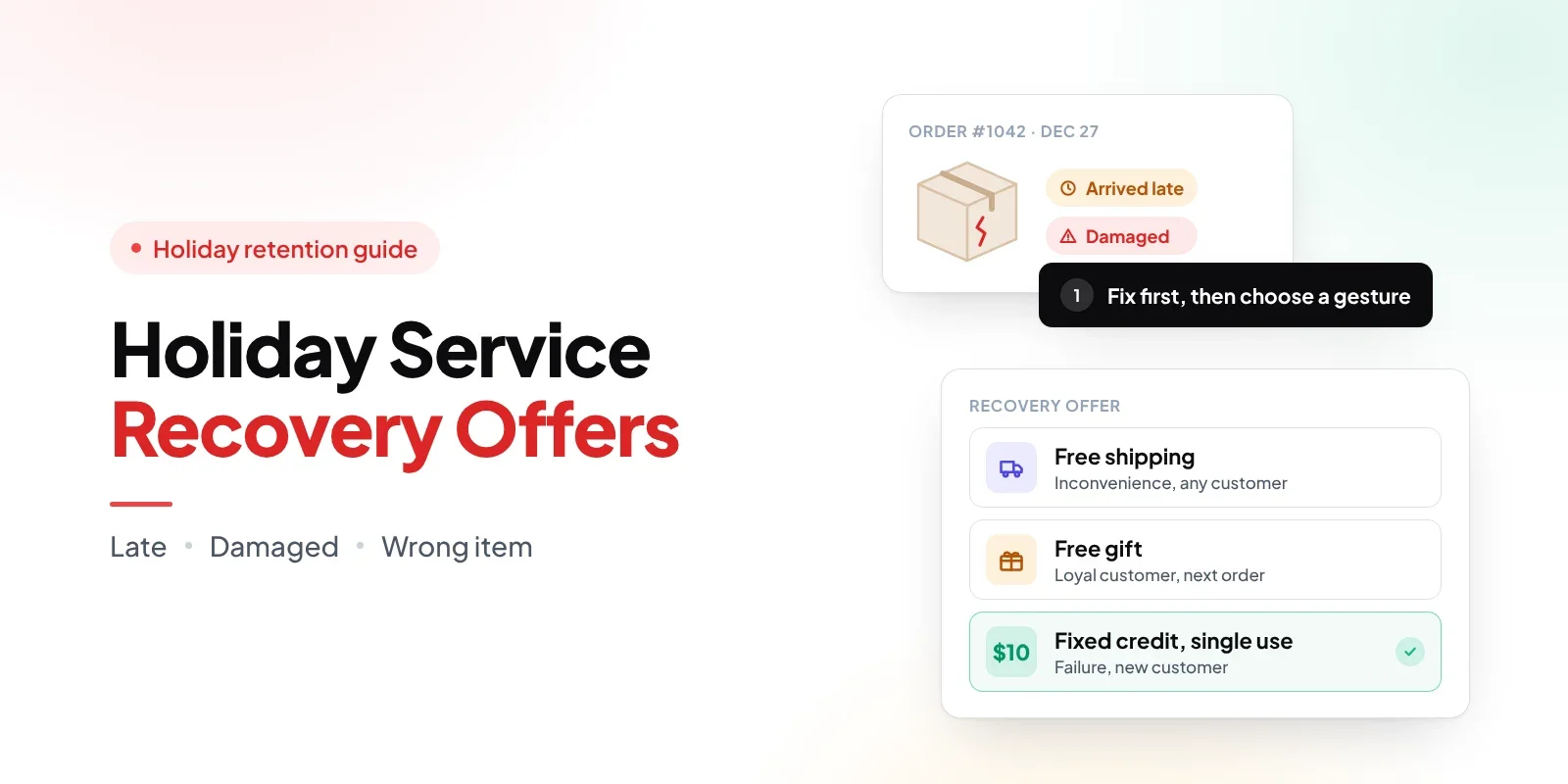
It's December 27. A customer's Christmas gift, a three-candle set, arrived two days late, and one jar is cracked. She has written to support twice. Your agent is about to send her a 20% code, because that's what someone sent a different customer last week.
That's how holiday service recovery offers usually work in a busy store. Every agent invents a fix: 10% here, free shipping there, a gift card for the angriest email. The result is uneven treatment, codes that leak, and margin given away without a clear reason.
The stakes are real. In AlixPartners' 2026 Home Delivery Survey, 27% of U.S. shoppers said they would stop buying from a retailer that offered only an apology for a late delivery, and another 28% said they'd be less likely to buy. But a bigger offer isn't always the better one, and a coupon can never stand in for a refund the customer is owed.
The short version is this: fix the order first, then size the gesture by how bad the miss was and who the customer is. This guide gives you a simple matrix for that decision, the five offers to choose from, how to send them on Shopify, and how to check that they pay back.
Short answer: First fix what the customer is owed: a replacement, a reshipment, or a refund. Then decide on a goodwill gesture by severity and relationship. A minor delay for a new customer may need only a clear apology and update, while a missed Christmas or a broken item usually earns free shipping, a free gift, or a fixed-amount credit on the next order. Keep percentage discounts for loyal, high-value customers, and never use a coupon in place of a refund.
TL;DR
Fix first, gesture second: a refund, replacement, or reshipment is owed, and a discount is optional.
Size the gesture with two questions: was it an inconvenience or a failure, and is this a new or loyal customer?
Free shipping and small gifts suit inconveniences, a fixed single-use credit suits failures, and a targeted percentage off is for loyal, high-value customers.
If the customer already got a free replacement and kept the original, they're made whole, and an extra offer is optional.
Send offers so they can't leak: lock codes to one customer and one use, add an end date, and decide how they combine with sales.
A coupon never replaces a refund the customer is owed, and in the U.S. the FTC's Mail Order Rule says so directly.
What Is a Service Recovery Offer?
A service recovery offer is what a store gives a customer after it fails to deliver what it promised. It has two parts: the fix the customer is owed, and an optional goodwill gesture meant to keep the relationship going.
Keeping those two parts separate is the most useful habit a support team can build. The fix is the replacement, the reshipment, the refund, or the honest new delivery date. The gesture is anything extra: free shipping next time, a small gift, or a credit. The fix is not negotiable. The gesture is a business decision, and it should be the same decision for the same situation, no matter which agent answers the ticket.
It helps to be realistic about what a gesture can do. Research on the "service recovery paradox" (the idea that a well-handled problem can leave customers happier than no problem at all) is mixed. A 2007 meta-analysis by de Matos, Henrique, and Rossi in the Journal of Service Research found that good recovery lifts satisfaction, but it doesn't consistently raise repurchase intentions or word of mouth. So the goal of a recovery offer is to keep the customer you already earned, not to win a bigger fan than you had before.
This moment sits inside the Christmas and fulfillment stage of the Q4-to-Q1 retention playbook, where the marketing has already done its job and the customer is judging the delivery.
Fix First: What the Customer Is Owed
The fix comes before any offer, every time. Until the customer has a replacement on the way, a refund, or a real answer, a discount code reads as "please go away."
Problem | What's owed (the fix) | Optional gesture |
|---|---|---|
Late, but still in time to be useful | An honest new date and working tracking; refund of shipping if they paid for a faster speed | Decided by the matrix |
Late, and it missed the occasion | A choice: keep it with a partial refund, or return it for a full refund, as your policy allows | Decided by the matrix |
Arrived damaged | A replacement or a refund; for low-value items, a photo instead of a return | Decided by the matrix |
Wrong item or wrong variant | The correct item at your cost; a prepaid return, or "keep it" when return shipping costs more than the item | Decided by the matrix |
Item missing from the box | Reship the missing item, or refund it | Decided by the matrix |
Customer typed the wrong address | Fast help to redirect or reship, at cost or at your discretion | Usually none |
Two rules sit above everything else in this article.
A coupon never replaces a refund the customer is owed. In the U.S., the Federal Trade Commission's Mail, Internet, or Telephone Order Merchandise Rule says that if you can't ship on time, you must give the buyer the option to accept the delay or cancel for a prompt refund. If they cancel, the FTC's business guide says you "cannot substitute credit toward future purchases, credit vouchers, or scrip" for that refund. Other countries have their own rules, so check where you sell. This isn't legal advice, but it's a clear line to put in your support policy.
No gesture until the fix is confirmed. Send the code or credit after the replacement has shipped or the refund has gone through. The same logic applies after the holidays, when holiday returns caused by damage or late delivery need to be resolved before any retention offer makes sense.
Is an Apology Enough?
Sometimes. For a small delay to a new customer, a fast and specific apology with a real update can be the right response. For most holiday misses, though, customers expect something more.
The data is fairly consistent. When AlixPartners asked U.S. shoppers how an apology-only response to a late delivery would affect them, only 3% said they don't expect compensation, and 9% said it wouldn't change their behavior. In a separate survey of more than 1,000 U.S. shoppers by HubBox, reported in October 2024, 63% said they expect delivery charges to be waived after a delay, 54% expect a free delivery code for the next order, and 53% expect money off the next order.
What shoppers want most, though, is information. AlixPartners found that 90% say updated delivery dates and clear explanations matter when an order runs late. A good apology covers four things:
What happened, in one plain sentence.
What you've already done about it.
When they'll have their order, or their money.
How to reach a person if anything else goes wrong.
If you can't do those four things, no discount will cover the gap.
How to Choose Service Recovery Offers: The Recovery Offer Matrix
The Recovery Offer Matrix sizes the gesture with two questions: how bad was the miss, and how established is the relationship? Answer both, and the default offer falls out of the grid.
Severity: - Inconvenience: the order was late but still arrived in time to be useful, the box was crushed but the product is fine, or a small item was missing and reshipped quickly. - Failure: the order missed the occasion (a Christmas gift arriving after December 25), the product arrived broken or unusable, the wrong item or variant was sent, or the customer had to chase support more than once.
Relationship: - New: this was their first order, which is common for BFCM and holiday shoppers. - Loyal: two or more previous orders, or a known VIP or subscriber.
New customer | Loyal customer | |
|---|---|---|
Inconvenience | Fix + clear update. Optional: free shipping on the next order. | Fix + free shipping on the next order, or a small free gift with it. |
Failure | Fix + a fixed, single-use credit on the next order. | Fix + a fixed credit or a gift. A personal, targeted percentage off only for high-value customers or repeat failures. |
Why does a new customer with a failure get a credit instead of a gift? Because they have no habit of buying from you yet. A clear dollar amount gives them a concrete reason to try you again. A loyal customer already knows your products, so a gift or free shipping on an order they were likely to place often lands better than cash.
Two Modifiers: Order Value and What You've Already Given
Order value. For an order well above your average order value, a flat $10 credit can feel small. Size the credit as a share of the order instead, set it as a fixed dollar amount, and cap it. For example, a store might use 10% of the order value, rounded to a dollar amount, with a $40 cap.
What you've already given. If you sent a free replacement and let the customer keep the original, or refunded in full and didn't ask for the item back, the customer is already ahead. Drop one step, which usually means an apology and the fix, or free shipping at most.
When to Step Up One Level
Move one step toward a bigger gesture when:
The customer had to contact you more than once to get an answer.
It's the second problem for the same customer this year.
The order was a gift and it missed the occasion.
The customer paid for return shipping on your mistake (refund it, then step up).
When Nothing Extra Is the Right Answer
A gesture isn't always needed. Skip it when the customer caused the problem, such as a mistyped address; when they're already made whole; or when you showed a clear delay warning before checkout and they chose to order anyway. In these cases, warm, fast help is the right response, and a credit would only teach customers to expect one.
Carrier delays are different. The customer bought from you, not from the carrier, so treat a carrier delay as your miss and file the carrier claim separately.
The Five Recovery Offers and When Each One Fits
There are five sensible gestures, and they differ mostly in cost control. Fixed, capped offers should be the default, and percentage offers should be the exception.
Offer | Best for | Cost to you | Watch out for |
|---|---|---|---|
No additional offer (fix + apology) | Minor inconvenience, already made whole, customer-caused problems | Nothing beyond the fix | A generic apology can feel cold, so make it specific |
Free shipping on the next order | Delays, and inconveniences for any customer | Your shipping cost, only if they order again | Feels small to customers who already qualify for free shipping |
Free gift with the next order | Loyal customers | The cost of the gift, only if they order again | The gift must be in stock in January, and it shouldn't be the item that broke |
Fixed credit (single-use $ off) | Failures, especially for new customers | Known and capped | Add an end date, and only add a minimum order if it's fair |
Targeted % off | Loyal, high-value customers, or steering them back to one collection | Grows with the next basket | Can stack with sales; reserve it for few cases |
Free shipping deserves more credit than it gets. It matches what delayed shoppers say they want, it costs you only your label cost, and it only costs anything if the customer orders again. If you already run automatic free shipping discounts above a threshold, use it for customers likely to place smaller orders, or choose a different gesture.
The choice between a code and an automatic offer also matters. A code is easy to send in a support reply, while an automatic offer applies without the customer having to find anything. Each has trade-offs, and it's worth knowing how automatic discounts and discount codes behave differently before you pick one for your policy.
What a Recovery Offer Really Costs
A gesture only costs money if the customer comes back, and when they do, the new order brings its own margin. That's why fixed offers are easier to budget than percentages.
Here's an illustrative example. A customer's $80 order arrives damaged. The store's gross margin is 55%, so the original order earned about $44 before the problem. The replacement (product cost plus a new label) is the fix, and it isn't optional. Now compare three gestures on a typical $90 second order:
Gesture | Cost if the customer reorders | Notes |
|---|---|---|
20% off the next order | $18 | Rises with a bigger basket |
$10 fixed credit | $10 | Same cost whatever they buy |
Free shipping on the next order | About $8 (the store's label cost) | Feels smaller to the customer, costs the least |
A simple rule keeps this in check: the gesture shouldn't be worth more than the gross margin of the original order. Write that ceiling into your policy, and you'll know the most any single case can cost before December starts. If you want to see how a discount eats into each order, work through the profit margin after a discount for your own numbers.
Holiday Timing: Before Christmas, After Christmas, and January
Timing changes both the severity and the offer. The same two-day delay is an inconvenience in early December and a failure on December 26.
Before the shipping cutoff. When you know an order will be late, tell the customer before they ask. Offer a faster shipping upgrade or the option to send a gift card instead, because those solve the real problem, which is the gift. USPS's recommended send-by dates for Christmas 2026 fall on December 17–19, which makes the last safe shipping week before Christmas the time to set expectations clearly.
After the occasion is missed. Treat any gift that arrives after December 25 as a failure, even if the parcel was "only" two days late. The customer didn't buy a candle set. They bought a Christmas present.
In January. Give recovery offers an end date 30 to 60 days out, so they land in Q1 when the customer is planning their next purchase. A code that expires on December 31 mostly gets used on the next sale they would have bought from anyway, or not at all.
Gift orders. When a gift arrives late or broken, the person who paid is your customer, so the gesture goes to them. With the replacement, you can include a short note for the recipient. This matters because orders where the buyer and the user are different people behave differently in Q1, and the buyer is the one you're trying to keep.
How to Deliver the Offer on Shopify
Shopify gives you four native ways to deliver a gesture, and an app adds a fifth. Pick the one that fits the offer and keeps it from being shared.
Method | Good for | Limits to know |
|---|---|---|
Discount code limited to specific customers, one use per customer, with an end date | One-off cases | Created by hand for each case; a code can apply to up to 100 specific customers |
Store credit | A fixed credit that feels like money back | Customers must use new customer accounts or Shop Pay; the full balance must be applied at once |
Gift card | A fixed credit the customer can forward, for example to a gift recipient | Works like cash; up to $2,000 per card; expiry rules depend on local law |
Partial refund (for example, shipping) | Late orders where the customer paid for faster shipping | Money back now, but nothing that invites a second order |
Customer tag + automatic offer (app) | A batch of customers hit by the same problem | Needs an app such as DiscountRay, or a custom setup |
A few details from the Shopify Help Center are worth knowing before you choose:
Discount codes can be limited to specific customers or customer segments, and to one use per customer. Shopify's discount types include amount off (a percentage or a fixed amount), Buy X Get Y, and free shipping.
Store credit is issued from the customer's profile (Edit in the Store credit section, then Issue credit) or chosen as a refund method. It isn't available for legacy customer accounts. You can set an expiry date, and the customer is emailed only if you select Notify customer. It works on the Online Store, Point of Sale, and Shop. For stores created on or after May 12, 2025, orders paid with store credit incur third-party transaction fees on the credit amount.
Gift cards are issued from Products > Gift cards > Create gift card, then Send gift card. Some regions don't allow gift card expiry dates.
Refunds can be partial, can include shipping, and can go to the original payment method, store credit, or both.
Keep Recovery Codes From Leaking or Stacking
A recovery code is a private apology. Once it lands on a coupon site, it becomes a public discount. Three settings prevent most problems:
Lock it to one customer and one use. This is the main defense against discount code sharing and abuse.
Add an end date. Thirty to 60 days is enough for a real second order.
Decide how it combines with sales. A $10 credit stacked on a 30% January sale may be more than you planned. Check how product, order, and shipping discounts combine and set the code's combination settings on purpose.
Finally, tag every customer who receives a gesture (for example, recovery-dec26). Without that tag, you won't be able to measure anything in January.
Where DiscountRay Fits, and Where It Doesn't
DiscountRay, a Shopify discount app by EFOLI, can run the gesture once you've decided on it. It doesn't spot the problem, fix the order, or talk to the customer.
What it can do, depending on your plan:
Recovery offer | How to run it in DiscountRay | Plan |
|---|---|---|
Fixed credit for one customer | A personalized single-use code tied to that customer's email, with an end date | Growth |
The same offer for every customer in a late batch | Tag the customers, then a personalized discount that targets the tag, so there's no code to type | Pro |
Free shipping or a free gift on the next order | A personalized discount with a free shipping or free gift reward | Pro |
Step up for loyal customers | An order-history condition combined with the recovery tag | Pro |
DiscountRay's personalized discounts by tag, list, or order history can reward a percentage, a fixed amount, a free gift, or free shipping, and they have active dates and combination settings.
What it doesn't do: DiscountRay does not detect late or damaged orders, issue refunds, store credit, or gift cards, or send the apology. Those stay in Shopify and your helpdesk.
A simple setup for a batch of affected customers (illustrative):
Tag each affected customer
recovery-dec26in Shopify, by hand or with Shopify Flow.In DiscountRay, create a personalized discount.
Set the condition to customer tag is
recovery-dec26.Choose the reward, such as free shipping or $10 off.
Set active dates, such as January 2 to February 28, and choose how it combines with other discounts.
A Worked Example: One December Shipment, Four Customers
Here's how the matrix works on one bad day. An illustrative candle brand has a carrier delay and a packing error hit the same batch of orders on December 20.
Customer | Situation | Severity | Relationship | Fix | Gesture | Cost if they reorder |
|---|---|---|---|---|---|---|
A | Arrived December 23, two days late | Inconvenience | New | Apology and tracking update | Free shipping on the next order | About $8 |
B | Gift, arrived December 27 | Failure (missed Christmas) | Loyal, 4 orders | Partial refund offered, apology | $10 fixed credit, plus a note for the recipient | $10 |
C | One jar cracked | Failure | New | Replacement shipped first | $10 fixed credit, sent after the replacement ships | $10 |
D | Wrong scent, second issue this year | Failure, stepped up | Loyal VIP | Correct candle sent, keeps the wrong one | 15% off her favorite collection until February 28 | About $14 on a $90 order |
Notice customer D. She kept the wrong candle, which would normally lower the gesture by one step. But it's her second problem this year and she's a high-value customer, so the step up and the step down roughly cancel out, and a targeted percentage on one collection fits.
Write It Down: A Recovery Offer Policy Card for Your Team
A one-page policy is what turns this from good intentions into consistent treatment. Seasonal support staff should be able to apply it without asking a manager.
Situation | Fix | Gesture | How to send | End date | Exceptions approved by |
|---|---|---|---|---|---|
Inconvenience, new | Update + apology | Optional free shipping | Customer-locked code or tag | 60 days | Not needed |
Inconvenience, loyal | Update + apology | Free shipping or small gift | Tag + automatic offer | 60 days | Not needed |
Failure, new | Replace or refund | $10 fixed credit (or 10% of order as $, capped) | Single-use code tied to email | 60 days | Not needed |
Failure, loyal | Replace or refund | Fixed credit or gift | Tag + automatic offer | 60 days | Not needed |
Failure, high-value or repeat | Replace or refund | Targeted % off one collection | Customer-locked code | 45 days | Support lead |
Add three lines under the table: no gesture before the fix, never a gesture instead of a refund, and tag every customer who gets one. The dollar amounts above are examples, so set your own from your margins.
How to Measure Whether Recovery Offers Work
Measure recovery the same way you'd measure any retention offer: by what customers do next, not by how many codes were redeemed.
Track these numbers in Q1 for every customer with the recovery tag:
Repeat rate within 90 days for affected customers, by offer type.
Redemption rate by offer type.
Cost per returning customer (total gesture cost divided by customers who ordered again).
Repeat contacts: did the customer need to write again about the same issue?
Satisfaction score on the recovery ticket, if your helpdesk collects one.
If you have enough volume, compare affected customers who got a gesture with similar affected customers who got only the fix. Be honest about the limits here. A small store won't get statistical certainty from a few dozen cases, but it will see whether free shipping and a $10 credit lead to noticeably different behavior.
Common Mistakes With Holiday Service Recovery
Sending the code before the fix. It reads as a brush-off.
The same 20% for everyone. It overpays small problems and can underpay big ones.
Codes with no end date or customer lock. They leak and turn up in January sales.
Offering credit when a refund is owed. In the U.S., that can break the FTC's Mail Order Rule.
Rewarding the loudest complaint. The policy should decide the gesture, not the tone of the email.
Not tagging gestures. Without a tag, you can't measure anything later.
Conclusion
The best holiday service recovery offers are boring in a good way. Fix what the customer is owed, then use the Recovery Offer Matrix to choose a gesture by severity and relationship. Prefer fixed, capped offers like free shipping, a small gift, or a single-use credit, and save percentage discounts for loyal, high-value customers. Lock each offer to one customer, give it an end date in Q1, and tag it so you can see in January whether it brought people back.
Recovery is one stage of holiday customer retention on Shopify. Handled well, it keeps a December mistake from becoming a lost customer.
FAQs
What should I offer a customer whose order arrived late?
Start with a specific apology, an updated delivery date, and a refund of any shipping they paid for a faster speed. If the delay made a gift miss the occasion, or the customer has ordered from you before, add free shipping or a small fixed credit on their next order, with an end date in Q1.
How much compensation should I give for a late delivery?
There's no standard amount. Size the gesture by how bad the miss was and how established the customer is, and use a fixed dollar amount you can afford. A useful ceiling is the gross margin of the original order, so no single case costs more than the order earned.
Is an apology enough for a late delivery?
Sometimes. For a small delay to a new customer, a fast, specific apology with a real update can be enough. But most shoppers expect more: in AlixPartners' 2026 survey, only 3% of U.S. shoppers said they don't expect compensation for late deliveries.
Should I give a refund or a discount code for a damaged item?
A replacement or refund comes first, because that's what the customer is owed. A discount code is an optional extra. Send it only after the replacement has shipped or the refund has gone through, so it reads as a thank-you for their patience, not a substitute for the fix.
Can I give store credit instead of a refund?
Only when the customer agrees and no refund is legally required. In the U.S., if you can't ship on time and the customer cancels, the FTC's Mail Order Rule says you can't substitute credit toward future purchases for the refund. Rules differ by country, so check where you sell.
Should I let the customer keep the wrong item?
Often, yes. When return shipping and handling cost more than the item is worth, letting the customer keep it is cheaper and faster. Send the correct item at your cost. Since the customer ends up ahead, an extra gesture is usually optional.
How do I send a discount code to just one customer on Shopify?
Create a discount code in Shopify, set eligibility to specific customers, choose the customer, limit it to one use per customer, and add an end date. An app like DiscountRay can also create a single-use code tied to one customer's email.
Should I compensate a customer if the carrier caused the delay?
Usually, yes. The customer bought from your store, not from the carrier, so treat a carrier delay as your miss and apply your normal policy. File a claim with the carrier separately if the delay qualifies.
What if the customer entered the wrong address?
Help them fix it quickly, and reship at cost or at your discretion. A goodwill credit isn't expected when the customer caused the problem, and giving one can teach customers to expect it.
Can DiscountRay detect late orders or issue refunds?
No. DiscountRay creates and applies discounts, such as a single-use code tied to one customer or an offer targeted by customer tag. Detecting delivery problems, refunds, store credit, gift cards, and customer messages stay in Shopify and your helpdesk.

Syeda Rehnoma Tanzom
This article is written by Syeda Rehnoma Tanzom, an SEO content writer with 3+ years of experience specializing in eCommerce content. What makes the work here a little different? A close collaboration with support teams to understand what merchants are actually going through, their frustrations, their questions, and their wins. The goal is simple: write content that speaks to real problems, not just search engines. When not buried in keywords and content briefs, you'll find her nose-deep in a good book, binge-watching true crime documentaries or psychological thrillers, and occasionally switching gears with a feel-good rom-com.
Cet article a été relu par le Technical Support Team de DiscountRay, qui aide régulièrement les marchands Shopify à tester la configuration des remises, l’éligibilité des clients, le comportement du panier et les problèmes de remise au moment du paiement.