You just built a "VIP" discount for your best customers, picked a targeting option in the dropdown, and hit save. A week later, a customer who's spent twelve dollars with you ever uses the code, while one of your actual top spenders never sees it at all. Nothing about the setup was technically broken; you just picked the wrong eligibility option for what you were actually trying to do.
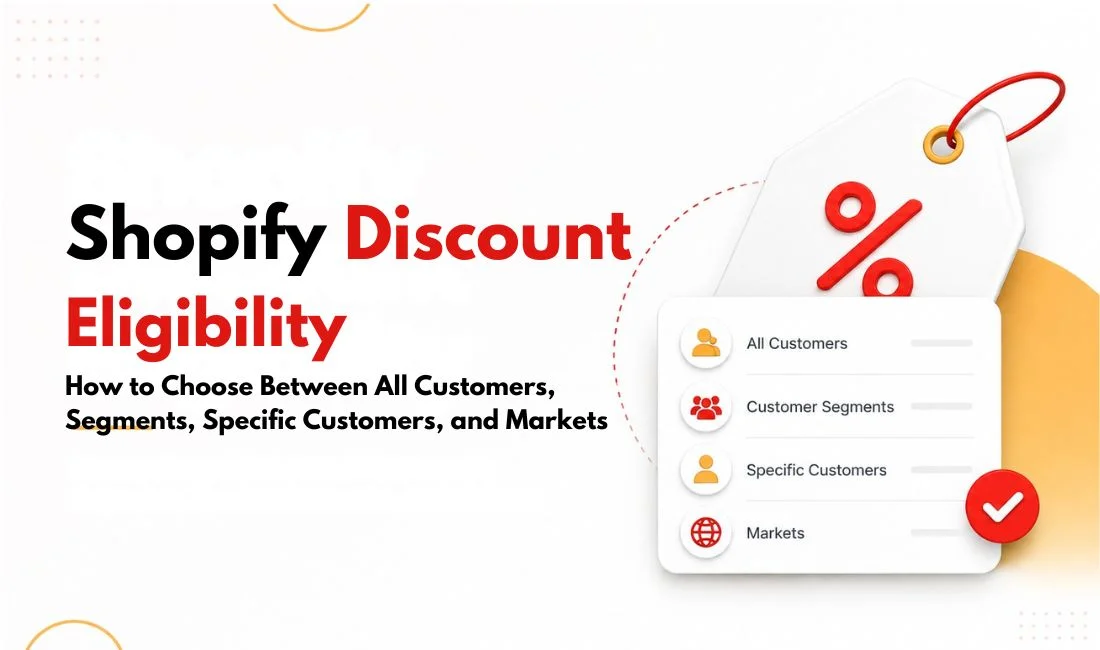
That's the trap with Shopify discount eligibility. Shopify gives you four ways to decide who a discount actually applies to: All customers, Customer segments, Specific customers, or Markets. They sit in the same dropdown and look like four flavors of the same setting, but they're built to do different jobs, and Shopify doesn't warn you when you've picked one that doesn't match what you're actually trying to do.
Get it wrong and the cost isn't abstract. A loyalty discount meant to reward repeat buyers can quietly go stale because you built a static list instead of a live segment. A B2B-only price can leak through to your regular retail customers because eligibility was never scoped to a market. A location-based promotion can apply to customers you never meant to include, because a segment counts every address on a customer's profile, not just where their current order is shipping. Each of these is a real campaign underperforming, or worse, a pricing mistake that costs you margin without you noticing until later.
This piece walks through what each of the four eligibility options is actually for, where B2B and personalized offers commonly go wrong, and one setup mistake worth testing for before you launch anything tied to location.
TL;DR
Shopify discount eligibility gives you four options: All customers, Customer segments, Specific customers, and Markets, and they're built for different jobs, not interchangeable versions of the same thing.
Customer segments update automatically as shoppers meet or drop your criteria; Specific customers is a static list you build and maintain by hand.
A single discount can only use one eligibility type at a time, not a combination, and market eligibility now covers every discount type, including B2B company locations.
In a blended B2B and D2C store, discounts apply to both customer types by default; restricting a discount to B2B buyers only means assigning it a B2B market, not a customer segment.
A country or region-based customer segment isn't the same as restricting an order's shipping destination; a customer with addresses in more than one country can belong to more than one segment, so it's worth testing location-based eligibility before relying on it for a regional promotion.
What Discount Eligibility Actually Controls
Every Shopify discount, whether it's a percentage off, a fixed amount, free shipping, or a buy-X-get-Y offer, has an Eligibility section separate from its product, collection, or minimum purchase conditions. Eligibility answers one question only: who is allowed to use this discount. You set it from the discount's edit screen by choosing All customers, Specific customers, Customer segments, or Markets, then assigning the relevant list, segment, or market underneath.
The Four Eligibility Options, and Who Each One Actually Fits
All customers is the default, and it's exactly what it sounds like: no targeting at all. Anyone who meets the discount's other conditions (minimum spend, eligible products, active dates) can use it. This is the simplest choice for a storewide promotion that doesn't need customer targeting, but it's also why a lot of merchants assume personalization isn't possible on Shopify at all.
Customer segments are dynamic, rule-based groups built from customer data such as order history, total spend, or location. A segment for "customers who've spent over $500" automatically adds and removes people as they cross that line, with no manual upkeep from you. Worth knowing: segment eligibility for automatic discounts (the kind that apply without a code) is fairly recent. Shopify only added it in August 2025, so if a store hasn't touched its automatic discount setup since before then, this option may genuinely be new territory.
Specific customers is a manually selected list of customer profiles. The list doesn't automatically change based on rules the way a customer segment does; it stays exactly as you left it until you edit it again.
Markets target a discount to a region, a retail location, or a B2B company location, and it's the newest of the four. Shopify extended market eligibility to every discount type in May 2026.
One rule applies across all four: a single discount can't have more than one eligibility type assigned to it. You choose All customers, Customer segments, Specific customers, or Markets, not a combination.
Eligibility Type | Best For | Updates Automatically? | Example |
All customers | Storewide promotions with no targeting | No, applies to everyone by default | 15% off sitewide sale |
Customer segments | Rule-based groups that should stay current | Yes, membership updates as criteria change | Customers who've spent over $500 |
Specific customers | A small, deliberately hand-picked list | No, fixed until manually edited | 20 selected early-access customers |
Markets | Region, retail location, or B2B company targeting | Membership follows market assignment | B2B-only company discount |
Segments vs. Specific Customers: The Mix-Up That Breaks Personalization
This is a common source of confusion. Segments and specific customers both let you narrow who gets a discount, so it's easy to treat them as the same setting with two names. They're not. A segment is a live rule; a specific-customer list is a snapshot.
Say you build a "VIP" discount for customers who've spent over $500. If you use a customer segment, that group updates itself forever, no extra work needed. If you use specific customers instead, you've frozen the list at whoever qualified the day you built it. Six months later, new high spenders won't get the discount, and customers who've since churned still will, because nobody told the list to update. Neither option is wrong; they're just built for different jobs. Segments suit anything meant to run on autopilot. Specific customers suits a one-off list you're deliberately hand-picking, like beta testers or a small group of VIPs you want personal control over.
B2B and Personalized Offers: Where This Gets Missed
If a store sells to both regular customers and B2B buyers from the same Shopify instance (a blended store), there's a default behavior worth knowing before it surprises anyone: any existing discount applies to both B2B and D2C customers automatically. Nothing separates them unless you tell Shopify to.
To make a discount B2B-only, the correct move is to assign it a B2B market, not a customer segment. That's a common mix-up, since segments feel like the natural tool for "target this group of customers," but B2B targeting in Shopify's eligibility system runs through markets, tied to company locations, not through the customer segment system. If your store is planning company-specific pricing alongside general segment-based offers (loyalty tiers, high-spender discounts, and so on), you'll likely end up using both eligibility types across different discounts, since a single discount can only use one. This is also where volume pricing and eligibility intersect for B2B buyers specifically.
One Setup Mistake Worth Testing For
A country or region-based customer segment isn't the same thing as restricting a specific order's shipping destination, and that distinction is easy to miss. Shopify's own segment filter reference confirms that a country-based segment includes any customer with a matching address on file, and a customer with addresses in more than one country can end up counted in more than one country segment. So a segment built for "customers in the US" isn't strictly the same as "orders shipping to a US address."
That distinction showed up in a real case on the Shopify Community: a merchant built a US-based customer segment, restricted a discount code to it, and found a customer with a Dutch shipping address was still able to apply the code. Rather than a bug, it's a good illustration of the segment-versus-shipping-destination gap above, since a customer's stored address history doesn't necessarily match where a given order is actually headed.
The practical takeaway: after building a segment tied to location, place a real test order using an address outside that segment and confirm the discount doesn't apply. It takes a few minutes and it's the clearest way to know your eligibility rule is enforcing what you think it's enforcing.
Where DiscountRay Fits
DiscountRay's personalized discount feature, available on its Pro plan, supports targeting by B2B company and customer lists, by country, and by individual customer, all managed within the app's own discount workflow. That's a useful fit for a campaign that needs more targeting logic than a single storewide discount, since it lets a merchant build B2B, country, and customer-list conditions into one offer without hopping between the app and Shopify's native eligibility settings. Shopify's native eligibility rules still apply regardless, so DiscountRay is best thought of as an additional layer for building the offer, not a substitute for understanding the eligibility decision this piece has walked through.
Conclusion
There's no single "best" setting for Shopify discount eligibility, because each of the four options is built for a different situation. All customers is right for a storewide promotion with no targeting needed. Customer segments fit loyalty tiers, high-spender rewards, or any offer meant to update itself without ongoing maintenance. Specific customers fits a small, deliberately hand-picked list, like early access for a fixed group. Markets fits anything tied to location or B2B company targeting, including keeping B2B pricing separate from general D2C offers in a blended store. Getting eligibility right isn't about picking the most advanced-sounding option; it's about matching the option to what the discount is actually supposed to do.
FAQ
Can I use customer segments and market eligibility on the same discount?
Do automatic discounts support customer segment eligibility?
Why isn't my customer segment discount working for a customer who should qualify?
Can a first-time customer use a customer segment discount?
How do I create a discount that only applies to B2B customers?
What's the difference between "Specific customers" and "Customer segments" eligibility?

Syeda Rehnoma Tanzom
This article is written by Syeda Rehnoma Tanzom, an SEO content writer with 3+ years of experience specializing in eCommerce content. What makes the work here a little different? A close collaboration with support teams to understand what merchants are actually going through, their frustrations, their questions, and their wins. The goal is simple: write content that speaks to real problems, not just search engines. When not buried in keywords and content briefs, you'll find her nose-deep in a good book, binge-watching true crime documentaries or psychological thrillers, and occasionally switching gears with a feel-good rom-com.
This article was reviewed by the DiscountRay Technical Support Team, who regularly helps Shopify merchants test discount setup, customer eligibility, cart behavior, and checkout-related discount issues.