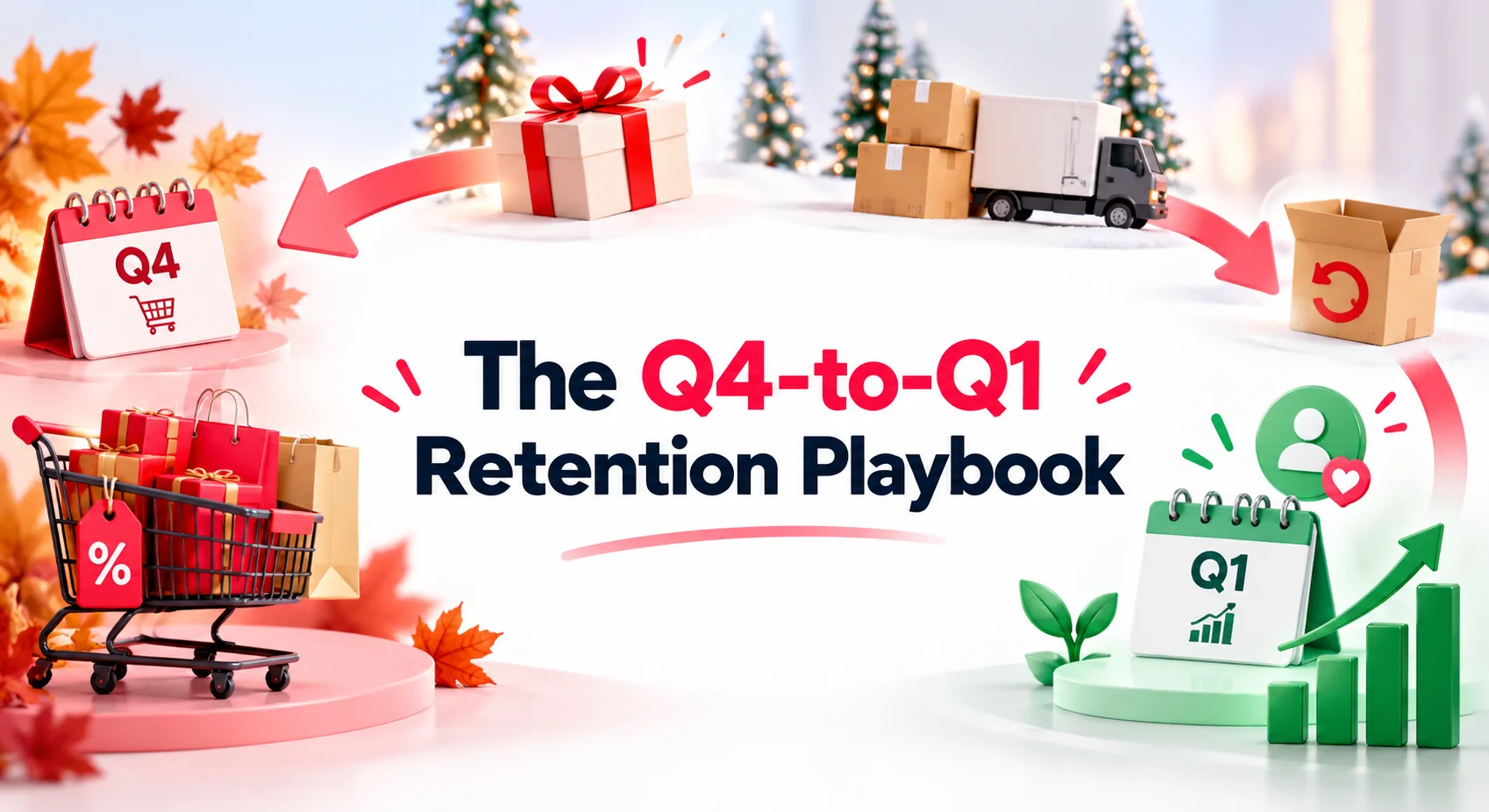
Q4 can make a Shopify store feel like it has two completely different businesses running at once. October is about preparing for the rush. November brings BFCM and a wave of new customers. December shifts toward gifting, deadlines, and fulfillment. Then January arrives, the orders slow down, returns start coming in, and the team has to figure out what happened to all those customers who bought during the holidays.
That last part is where many stores lose an opportunity.
The goal of Q4 should not be simply to acquire as many customers as possible. It should be to give those customers a reason to come back after the holiday season.
There is a practical reason to take the January period seriously. The National Retail Federation reports that 71% of consumers are less likely to shop with a retailer again after a poor returns experience. It also found that retailers expected 17% of holiday sales to be returned in 2025, showing how much of the customer relationship continues after the original purchase.
So retention does not begin when you send a January promotional email. It begins much earlier, with the offer you make in November, the delivery experience in December, the way you handle a return, and the reason you give someone to consider your store again.
This is a Q4-to-Q1 customer retention playbook, not a list of ten discount ideas. The question throughout the season should be:
What should we do at this stage to increase the chance that this customer comes back at the next stage?
Why Q4 Customer Retention Is Different
Holiday customers do not all arrive with the same intention.
Someone buying a product during BFCM may be buying for themselves. Someone purchasing in December may be buying a gift. Another customer may have discovered your brand for the first time because a friend recommended it.
Their reasons for purchasing are different, so treating every new customer with the same follow-up message is unlikely to create the strongest relationship.
There is another problem: Q4 is often treated as the finish line when it should be treated as the beginning of the next purchase cycle.
A merchant sees a successful BFCM weekend, a strong December, and impressive holiday revenue. But the more important question is what happens afterward.
Did first-time customers return?
Did gift recipients discover the brand?
Did customers who had a good experience receive a relevant reason to purchase again?
Did returns become a reason to reconnect, or simply a refund?
A retention strategy gives you a way to answer these questions before the season gets hectic.
The Q4-to-Q1 Customer Retention Framework
A useful way to approach holiday retention is to divide the season into six stages:
Prepare → Acquire → Fulfill → Delight → Recover → Re-engage
Each stage has a different job.
Season stage | Main customer moment | Retention goal |
October–early November | Preparing to buy | Build trust and set expectations |
BFCM | First purchase | Acquire the right customers, not just more customers |
December gifting | Gift purchase | Create a memorable buying and delivery experience |
Christmas & fulfillment | Product received | Make the post-purchase experience easy |
Returns & exchanges | Potential frustration | Turn a difficult moment into a positive interaction |
January–Q1 | Next purchase | Give customers a relevant reason to return |
This framework is more useful than simply saying, “We need a retention campaign.”
It tells you what retention should look like at each point in the customer journey.
Stage 1: October to Early November - Prepare Before the Rush
Retention starts before the first holiday order.
That may sound strange because there is nothing to retain yet. But the expectations you establish before a customer buys can have a major effect on what happens afterward.
If your shipping deadlines are unclear, your return policy is difficult to find, or your product information leaves important questions unanswered, the customer experience can start going downhill before the order is even placed.
Get the basics right first
Before BFCM traffic arrives, review:
Product availability
Shipping deadlines
Delivery estimates
Holiday return policies
Exchange instructions
Customer support capacity
Product information
Gift-related messaging
Stock levels for your most important products
This is also the right time to decide which customers you want to retain.
Not every customer needs the same follow-up.
A first-time buyer who purchased one item during BFCM may need a different message from an existing VIP customer who has purchased five times this year.
That distinction becomes increasingly important as your customer base grows.
Stage 2: BFCM - Don't Confuse Acquisition With Retention
BFCM is usually treated as an acquisition event.
Run the promotion. Bring in traffic. Convert as many orders as possible.
That makes sense, but there is a problem with stopping there.
A customer who buys during BFCM has just given your store something valuable: a reason to start a relationship.
The question is what you do with it.
A huge discount can bring someone through the door, but a discount by itself does not guarantee that person will return. Your product, service, delivery, communication, and the relevance of your next offer all contribute to that decision.
Shopify's 2025 Global Holiday Retail Report found that 49% of surveyed shoppers cited discounts as a factor that would earn their loyalty, while free shipping and returns were cited by 41% and loyalty programs by 29%.
That is an important distinction.
Discounts can help create loyalty, but they are only one part of the experience.
During BFCM, focus on three things
1. Acquire customers who have a reason to come back.
If possible, understand what different customer groups are buying rather than treating every order as identical.
2. Avoid training customers to wait for the biggest discount.
If every communication after the first purchase is another deep promotion, customers may learn to associate your brand only with discounts.
3. Capture useful customer information.
Purchase history, products purchased, customer groups, and other first-party information can help you make future offers more relevant.
The objective is not simply:
“How many orders did BFCM generate?”
It is:
“How many of those new relationships can become repeat purchases?”
Stage 3: December - Turn Gifting Into a Relationship Opportunity
December changes the reason people buy.
A customer may be purchasing something for a partner, parent, child, colleague, friend, or employee. That means the person placing the order may not be the person who eventually uses the product.
This creates an interesting retention opportunity.
The recipient could become your next customer.
But that only happens if the experience makes it easy for them to discover and remember your brand.
Make the gift experience feel intentional
Packaging, delivery communication, product presentation, and a simple way to learn more about the brand all matter.
You do not need to turn the package into a marketing brochure.
Sometimes a thoughtful thank-you message, an easy-to-understand care guide, or a simple invitation to explore related products is enough.
The bigger principle is:
Do not treat the moment a package is delivered as the end of the customer journey.
It is another customer touchpoint.
Stage 4: Christmas and Fulfillment - Retention Can Be Won or Lost After Checkout
The customer has already paid. The marketing campaign has already done its job.
Now the operational side of the business takes over.
And this is where retention can quietly fall apart.
A delayed package, unclear tracking information, damaged product, or customer support response that takes too long can change how someone remembers the entire purchase.
Shopify's holiday fulfillment guidance highlights inventory, shipping, delivery expectations, order tracking, and returns as key parts of managing the holiday customer experience.
Give customers fewer reasons to contact support
That does not mean avoiding customer service. It means answering predictable questions before customers have to ask.
Make information easy to find:
When will my order arrive?
Can I change my shipping address?
What happens if the product arrives damaged?
Can I exchange it?
When does the holiday return window end?
How do I start a return?
Good service during Q4 is not just about resolving problems quickly.
It is about preventing unnecessary uncertainty in the first place.
Stage 5: January Returns and Exchanges - Don't Throw Away the Relationship
January is where the Q4-to-Q1 strategy gets tested.
Returns are inevitable for many holiday businesses. The customer may have received the wrong size, received something they already owned, changed their mind, or simply decided the product was not right for them.
A return does not automatically mean the customer is lost.
In fact, it can become one of the most important moments in the relationship.
The NRF's 2025 Retail Returns Landscape found that 76% of consumers were more likely to choose a return option offering an instant refund or exchange, while 71% said a poor returns experience made them less likely to shop with a retailer again.
That tells merchants something important:
The return process is part of retention.
Think beyond “refund completed”
When appropriate, give customers useful alternatives:
Exchange for another product
Store credit
Different size or variant
Related product
Clear next-purchase incentive
The goal is not to make returning difficult just to protect revenue.
The goal is to make the process fair and easy while creating an opportunity for the relationship to continue.
A return can reveal useful intent
Someone who returns a pair of shoes because of the wrong size is different from someone who returns because they did not like the product.
Someone exchanging a product for another color has a different relationship with your brand from someone asking for a complete refund.
Those differences can inform what happens next.
Stage 6: January to Q1 - Give Holiday Customers a Reason to Return
This is where many holiday strategies become too aggressive.
The holiday rush ends, revenue drops, and the instinct is:
“Send another discount.”
Sometimes that is the right answer.
Often, it is not.
A better question is:
What would make this particular customer want to buy again?
For some customers, it may be a replenishment reminder.
For others, it could be a complementary product.
For a gift recipient, it may be their first opportunity to purchase something for themselves.
For a loyal customer, it could be early access to a new collection.
For a price-sensitive customer, a targeted offer may make sense.
Retention works better when the reason to return is connected to the customer's previous interaction with the store.
Don't Give Every Customer the Same January Offer
This is one of the biggest mistakes merchants can make after a busy Q4.
Imagine these four customers:
Customer A: First purchase during BFCM
Customer B: Bought three times before Christmas
Customer C: Purchased a gift in December
Customer D: Has purchased frequently throughout the year
Sending all four the same “20% OFF” email wastes useful information.
You already know something about these customers.
Their purchase history can help determine what they should see next.
A better retention approach
Customer type | Possible Q1 approach |
First-time BFCM buyer | Welcome-back offer or related product |
Repeat customer | Loyalty-focused offer |
Gift buyer | Complementary product or self-purchase offer |
High-value customer | VIP access or exclusive pricing |
Customer who returned an item | Exchange or alternative product |
High-volume buyer | Quantity-based or personalized pricing |
The important point is not that every store needs all six offers.
The point is that retention should be based on customer context rather than one blanket promotion.
Where DiscountRay Fits Into the Q4-to-Q1 Retention Strategy

DiscountRay should not be treated as the entire retention strategy.
It cannot replace good fulfillment, customer service, useful communication, or a straightforward returns process.
What it can do is help merchants make the pricing part of the retention strategy more relevant.
Instead of giving every returning customer the same promotion, merchants can create discount rules based on customer and purchase conditions.
This Shopify customer retention discount app supports conditions through its personalized discount feature involving customers, customer tags, products, cart value, order history, country, currency, and other criteria.

That becomes particularly useful after Q4, when the store has accumulated new customer and order data.
1. Reward Previous Customers
A customer who purchased during BFCM can be treated differently from someone who has never purchased before.
For example, a merchant could create a targeted offer for an eligible customer group rather than publishing the same discount for everyone.
This gives the customer a reason to return without turning the offer into a storewide sale.
2. Use Customer Tags to Separate Groups
Not every customer needs the same retention message or price.
Merchants can use customer tags to identify groups such as:
Holiday buyers
VIP customers
Wholesale customers
Returning customers
Specific membership groups
DiscountRay can use customer-tag conditions when creating discount rules, allowing merchants to make offers more targeted.
3. Use Order History to Create More Relevant Offers
Order history can tell you more than the fact that someone purchased.
It can help identify customers who have purchased before and create rules around their previous relationship with the store.
For example, a merchant may want to target previous customers with a new offer rather than making that offer available to first-time visitors.
This is much closer to retention than simply putting another coupon code on the homepage.
4. Combine Customer and Cart Conditions
Sometimes the best retention offer depends on what the customer does next.
For example:
Returning customer + $100+ cart = special discount
Or:
VIP customer + selected products = exclusive offer
DiscountRay allows merchants to combine conditions using AND/OR logic, giving them more control over who qualifies for a particular discount.
5. Use Quantity-Based Offers When They Make Sense
Some customers naturally have a reason to buy more.
A business purchasing supplies, a family restocking household products, or a customer buying several gifts may respond better to a quantity-based offer than a simple percentage discount.
DiscountRay supports tiered pricing and quantity-based discounts, allowing merchants to structure offers around purchase volume.
The key is to use this strategically.
Do not offer a quantity discount simply because you can.
Use it when buying more genuinely creates value for both the customer and the business.
Product Page with DiscountRay

A Practical Q4-to-Q1 Retention Example
Imagine a skincare store acquires 5,000 new customers during BFCM.
The merchant could send all 5,000 customers the same January discount.
Or the merchant could look at what happened during Q4.
Some customers bought cleansers.
Some bought gift sets.
Some purchased premium products.
Some were existing customers making another purchase.
Some returned their orders.
Those groups represent different opportunities.
The store could then build a simple retention plan:
BFCM first-time buyers:
Introduce complementary products and a relevant return offer.
Gift-set buyers:
Reach out around the time they are likely to consider their next personal purchase.
Existing customers:
Give them an exclusive offer or early access instead of treating them like new customers.
High-value customers:
Use VIP treatment rather than a generic sitewide promotion.
Customers who exchanged products:
Recommend a suitable alternative rather than immediately pushing another unrelated sale.
DiscountRay can support the pricing and eligibility layer of these offers through customer, product, order history, cart, and other conditions. The communication itself can be handled through the merchant's existing email, SMS, loyalty, or CRM tools.
That separation matters.
A good retention strategy is not one app doing everything. It is several parts of the customer experience working together.
What Merchants Should Measure After Q4
If the goal is retention, holiday revenue alone is not enough.
You need to know what happened to the customers you acquired.
Track these numbers
Repeat purchase rate
How many holiday customers made another purchase during your chosen Q1 period?
Time to second purchase
How long did it take for a first-time holiday buyer to return?
Revenue from returning customers
How much Q1 revenue came from customers who had already purchased?
Offer performance
Which retention offers actually led to purchases?
Return-to-exchange rate
How often did customers choose an exchange or store credit instead of a refund?
Customer segment performance
Did VIPs, first-time buyers, gift buyers, or other groups behave differently?
You do not need a complicated dashboard to start.
Even a simple comparison between Q4 first-time customers and Q1 returning customers can tell you whether your holiday acquisition created lasting value.
A Simple Q4-to-Q1 Retention Checklist
October / Early November
Review your holiday shipping and return policies.
Check inventory for key products.
Identify your important customer groups.
Decide which customers you want to retain after Q4.
Plan post-purchase communication before BFCM begins.
BFCM
Focus on acquiring customers who fit your business, not just maximizing order volume.
Keep the customer experience simple during the busiest period.
Capture useful first-party customer information.
Avoid relying on one blanket discount for every customer.
December
Make gifting and delivery information clear.
Keep customers updated about their orders.
Make support easy to reach.
Use packaging and post-purchase communication to reinforce the brand experience.
Christmas and Fulfillment
Monitor delivery problems quickly.
Make tracking information easy to access.
Prepare your support team for common holiday questions.
Keep your returns process easy to understand.
January
Prepare for the expected increase in returns.
Treat exchanges and returns as customer touchpoints.
Segment holiday customers based on their relationship with your store.
Avoid sending every customer the same offer.
Start relevant Q1 re-engagement campaigns.
Q1
Measure repeat purchase behavior.
Identify which customer groups returned.
Review which offers worked.
Adjust your retention strategy based on actual customer behavior.
Use what you learned to improve the next Q4.
The Biggest Q4 Retention Mistake: Waiting Until January
If you wait until January to think about retention, you have already missed several opportunities.
The customer's experience has been shaped by everything that happened before then.
They remember whether the BFCM offer was clear.
They remember whether the product arrived on time.
They remember whether customer support helped when something went wrong.
They remember whether a return was simple or frustrating.
And they remember whether the brand continued to be useful after the holiday purchase.
That is why Q4-to-Q1 retention is one continuous process, not a January campaign.
The strongest retention strategy is built into the entire seasonal journey: attract the right customers, give them a good reason to trust you, deliver what you promised, handle problems well, and then give them a relevant reason to come back.
Final Takeaway: Q4 Should Lead Somewhere
A strong holiday season should not end when the Christmas orders are delivered.
It should lead somewhere.
October prepares the experience.
BFCM brings new customers in.
December tests fulfillment and service.
Christmas creates another brand touchpoint.
Returns can either damage or strengthen the relationship.
January gives merchants the first real chance to turn holiday buyers into repeat customers.
Q1 shows whether the strategy actually worked.
The best Shopify retention strategy is therefore not “send more emails” or “offer another discount.”
It is to understand what customers need at each stage of the holiday journey and give them a reason to continue that relationship after the season ends.
And when a targeted discount is genuinely the right reason, tools such as DiscountRay can help merchants make that offer more relevant instead of putting another generic coupon in front of everyone.
FAQs
How can Shopify stores retain holiday customers after Q4?
Why is customer retention important after the holiday season?
How can I turn BFCM customers into repeat buyers?
How do returns affect customer retention?
Should Shopify stores give every holiday customer a January discount?
How can DiscountRay help with holiday customer retention?
Can I use order history to create Shopify retention discounts?
What should Shopify merchants do in January after BFCM?

Anika Anamta Mehnaz
This article is written by Anika Anamta Mehnaz, a Content Writer and Content Marketing Strategist specializing in Shopify, eCommerce, and SaaS. With over four years of content writing experience, she creates SEO and AI search-optimized content that helps Shopify merchants make better business decisions through practical, research-backed insights. Her work covers Shopify apps, product variants, bundles, discounts, B2B commerce, and conversion-focused strategies. Outside of work, Anika enjoys watching anime, reading John Grisham novels, and discovering new ideas in digital marketing and e-commerce. If you enjoy discussing Shopify, content marketing, or online growth, feel free to connect with her. Twitter: https://x.com/mehnaz2201 Medium: https://medium.com/@mehnaz_78932
This article was reviewed by the DiscountRay Technical Support Team, who regularly helps Shopify merchants test discount setup, customer eligibility, cart behavior, and checkout-related discount issues.