A customer adds $82 worth of products to their cart during your Black Friday sale. Your store is offering 20% off everything, so they immediately receive $16.40 in savings. They're happy with the deal, but would they have purchased those products without such a large discount?
That's the challenge with blanket BFCM promotions. You reduce prices for customers who might have purchased anyway, while giving others little reason to add another product. More orders are coming in, but the extra discounts can eat into your profit.
A better approach is to make additional savings something customers earn by increasing their order value.
In this article, you'll learn how to design BFCM milestone offers around your average order value, create a sensible reward progression, choose between shipping, percentage discounts, and gifts, and protect your margins as customers reach higher spending thresholds.
Short Answer: How Can You Increase BFCM AOV Without Bigger Discounts?
Use spend-more-save-more offers that reward customers for reaching specific cart values or quantities rather than giving everyone the same discount.
For example, offer free shipping at $75, a 10% discount at $100, or a free gift at $150. These are possible reward structures, not universal thresholds. Choose the amounts using your store's typical order value, product margins, and fulfillment costs. Make each new milestone worth reaching without automatically stacking every reward.
This gives customers a reason to increase their cart value while helping you control how much each promotion costs.
TL;DR
Start with your normal AOV and order-value distribution before setting BFCM spending thresholds.
Put meaningful rewards above the amounts customers already spend naturally.
Choose between percentage discounts, fixed savings, free shipping, and gifts based on their actual costs.
Show customers how close they are to their next milestone, but make sure the displayed reward matches checkout.
Measure profit per order and total campaign performance, not just AOV or discount redemptions.
What Are BFCM Milestone Offers?
BFCM milestone offers are Black Friday and Cyber Monday promotions that reward customers when their cart reaches a specified spending amount or item quantity.
Instead of applying 20% off to every purchase, a merchant might offer $10 off orders over $100 or a free gift when a customer spends $150.
The difference is that the reward depends on completing a specific purchasing action.
There are two common approaches:
Spend-based milestones: Customers reach a cart-value threshold, such as spending $100 to receive a discount.
Quantity-based milestones: Customers purchase a specified number of eligible items, such as buying three products for one saving or five for a stronger saving.
Both approaches belong within a broader Shopify BFCM discount strategy, but milestone planning has a narrower purpose: getting customers to increase their purchases without spending unnecessarily on discounts.
The goal isn't simply to offer more rewards. It's to make the next reward attractive enough to justify adding another useful product.
Set BFCM Spend Thresholds Around Your Normal AOV
Before deciding what customers should earn, look at how much they already spend.
Imagine your Shopify store has an average order value of $80. You launch a free shipping promotion at $50.
The offer sounds appealing, but customers who regularly spend $80 will receive the benefit without changing their purchasing behavior.
You are now paying for an incentive that might not produce additional sales.
Find your current average order value
Shopify defines AOV as gross sales minus discounts, divided by the number of orders. Its Average order value over time report lets you review this metric across different periods.
Before setting thresholds, consider:
Your average order value over the last 30–90 days.
The spending ranges where most orders fall.
Your most common product prices and practical add-on combinations.
How much customers spent during your previous BFCM campaign, if that data is available.
AOV alone doesn't reveal everything. Two stores could have the same $80 AOV, even though one receives mostly $75–$85 orders and the other receives a mix of $30 and $150 orders.
The first store might need only a small incentive to encourage another item. The second might benefit from separate offers for different shopping behaviors.
Set a threshold customers can realistically reach
For a hypothetical store with an $80 AOV, you might test the following structure:
Threshold | Reward | Desired behavior |
|---|---|---|
$95 | Free shipping | Encourage a small add-on |
$120 | $12 off | Encourage a larger purchase |
$150 | Free gift | Encourage an additional complementary product |
These numbers are examples, not proven optimal thresholds.
The first milestone is close enough to the normal order value to feel achievable. The second encourages more meaningful additional spending. The third gives customers a different reason to increase their cart.
However, the thresholds should also reflect the prices of products customers actually want. A customer with a $92 cart needs a relevant product to make a $120 milestone attractive.
Practical rule: Avoid setting rewards at amounts customers already reach without an incentive. Also avoid making the next threshold so distant that adding another product feels unreasonable.
Design a Reward Progression, Not Just Three Discounts
One common mistake with Black Friday tiered offers is assuming each milestone needs a larger percentage discount.
For example:
Spend $100, get 10% off.
Spend $150, get 15% off.
Spend $200, get 20% off.
This can encourage additional spending, but the discount cost increases as well. At $200, a 20% order discount removes $40 from product revenue.
A more controlled progression could combine different reward types.
Example: A mixed-reward milestone structure
Cart milestone | Customer reward | Main consideration |
|---|---|---|
$75 | Free shipping | Actual shipping subsidy |
$100 | 10% off | Percentage discount cost |
$150 | Gift worth $25 retail | Actual gift and fulfillment cost |
This is a proposed reward menu, not an automatically cumulative offer.
A merchant could structure it so the highest unlocked reward replaces the previous reward, or allow selected rewards to accumulate when financially sensible.
The important point is that the customer should understand whether rewards replace or combine with one another.
If the free gift replaces a 10% discount, make sure the gift is genuinely attractive enough to justify the higher spending target. Its retail value alone does not guarantee customers will prefer it.
For a cumulative promotion, calculate the combined cost of shipping, discounts, and gifts before advertising the highest tier.
A good progression makes the next purchase more rewarding without making the entire order unnecessarily cheaper.
Choose Rewards Based on Customer Value and Merchant Cost
Different rewards can feel valuable to customers while having very different costs for your business.
Reward | When it makes sense | Main risk |
|---|---|---|
Percentage discount | Larger purchases with healthy margins | Savings grow with cart value |
Fixed discount | Merchants wanting a predictable discount amount | May feel less attractive at high thresholds |
Free shipping | When delivery charges influence purchase decisions | Expensive delivery destinations |
Free gift | When a complementary item offers meaningful value | Product, packaging, and fulfillment costs |
Quantity discount | Multiple units of eligible products | Discounting units customers would already buy |
Consider a $150 cart.
A 15% discount costs $22.50 in reduced product revenue. A free gift that normally sells for $25 might cost your business only $8 to purchase, although packaging and additional shipping expenses must also be considered.
That doesn't automatically make the gift the better choice. Customers must actually want it.
Similarly, free shipping may be affordable for lightweight accessories but expensive for bulky products or international destinations.
A useful way to compare rewards is to ask two questions: Would the customer add another product to earn this? And how much would that behavior cost us?
Your existing BFCM pricing and margin planning should determine the maximum reward cost before you build the milestone progression.
Check Whether Higher Milestones Actually Improve Profit
A higher AOV doesn't guarantee a more profitable campaign.
Consider a hypothetical accessories store with an $80 order and no promotional discount.
Order calculation | Normal order | Higher-value milestone order |
|---|---|---|
Product subtotal | $80 | $110 |
Product cost | $40 | $55 |
Promotional discount | $0 | $11 (10%) |
Shipping, packing, and payment costs | $10 | $12 |
Contribution after these costs | $30 | $32 |
The customer increases their cart from $80 to $110, earning a 10% discount.
The merchant receives $99 in product revenue after the discount and retains $32 after the listed costs, compared with $30 for the original order.
That's a $2 improvement in contribution for this particular order.
The example shows why a milestone might work, but it also exposes an important limitation.
The $11 discount applies to qualifying customers who would have spent $110 anyway. Those customers receive a reward without necessarily increasing their purchase.
To evaluate profitability, you must consider both customers who increase their carts and customers who naturally reach the threshold.
A simplified formula is:
Contribution per order = Product revenue after discounts − product costs − shipping subsidy − packing and payment costs − other variable costs.
Include acquisition costs where relevant, and account for returns when evaluating the completed campaign.
Before launching your highest milestone, calculate the reward cost across different product combinations, including low-margin products. A percentage discount that works for one cart might be unsuitable for another.
The existing smart discount strategies for protecting margins provide useful context for minimum-spend incentives. For BFCM milestones, go further by modeling every tier and the orders that would qualify even without additional spending.
Show Customers Their Progress Toward the Next Milestone
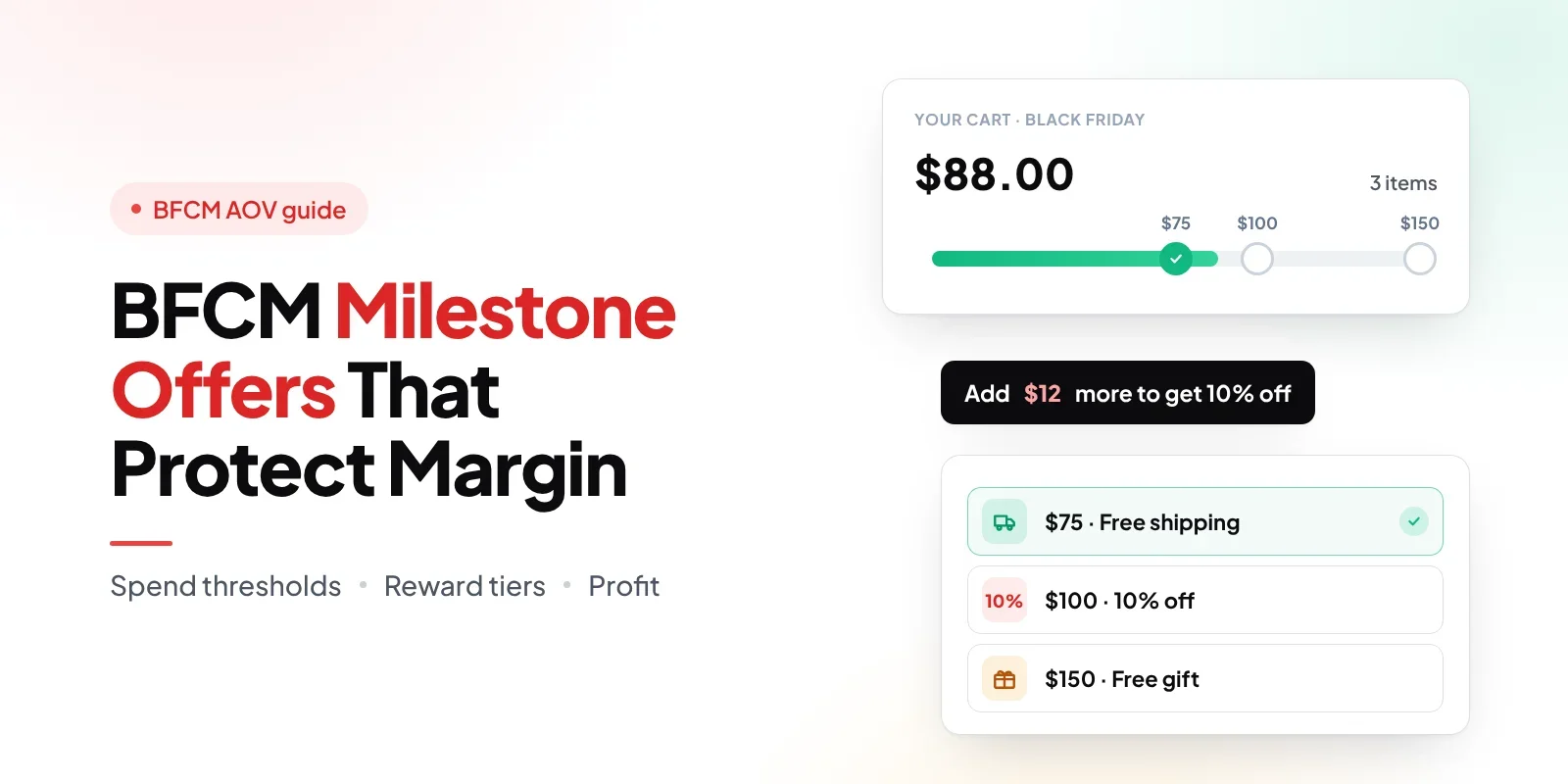
A customer with $88 in their cart may not remember that your store offers a reward at $100.
Simply placing the promotion in a homepage banner doesn't guarantee they will notice it while shopping.
A milestone progress bar makes the next reward easier to understand.
For example:
Your cart: $88
"Add $12 more to get 10% off your order."
When the customer reaches $100, the message can change to explain the reward they have earned and, when relevant, the next available milestone.
The message should help customers make a decision, not pressure them to buy products they don't need.
Where should milestone progress appear?
Useful placements include product pages, the cart drawer, and the cart page. The right placement depends on your theme and shopping experience.
Keep three principles in mind:
Show the exact amount remaining, using the same eligibility calculation as the actual promotion.
Make the reward and qualifying conditions understandable.
Update progress when products, quantities, or applicable discounts change.
Avoid displaying a reward as earned if the customer won't actually receive it at checkout.
If a discount changes the qualifying subtotal, the progress indicator must account for that difference. Otherwise, customers may see conflicting information between the cart and checkout.
Use Different Milestone Goals for Black Friday and Cyber Monday
Black Friday and Cyber Monday don't necessarily need identical milestone offers.
In 2026, Black Friday falls on November 27 and Cyber Monday on November 30.
Instead of increasing discount percentages every day, you can change the purchasing behavior you're encouraging.
Black Friday: Encourage larger carts
Black Friday may be a good time to test spend-based milestones that encourage customers to purchase complementary products together.
For example, a skincare merchant could offer a reward when customers add a cleanser and moisturizer, rather than reducing the price of every product across the store.
Cyber Monday: Encourage useful additional quantities
Cyber Monday could emphasize quantity-based rewards for replenishable products or multiple gifts.
For example:
Buy 3 eligible products and receive 5% off.
Buy 5 eligible products and receive 10% off.
These are illustrative tiers, and the discount should apply only to the eligible products or quantities defined in the campaign.
The change gives customers another reason to purchase without necessarily making Cyber Monday's discount deeper than Black Friday's.
It should also fit your wider BFCM discount calendar, so early customers aren't unexpectedly penalized for purchasing before the final promotional day.
How to Set Up BFCM Milestone Offers on Shopify
Shopify provides native discount tools for several common threshold promotions.
You can create automatic amount-off discounts with minimum purchase requirements, free shipping offers, and Buy X Get Y promotions. More advanced progression logic and storefront reward displays may require additional configuration or a compatible app.
Option 1: Use Shopify's native discounts
For a straightforward spend-based promotion:
Open Shopify Admin → Discounts → Create discount.
Choose an amount-off-order or free shipping discount, depending on your reward.
Set the minimum purchase requirement.
Configure eligibility, combination settings, and active dates.
Save the discount and test different cart values.
For multiple percentage or fixed-amount tiers, create separate eligible discounts where appropriate and configure their combination rules to produce the intended result.
For a free gift, Shopify's native Buy X Get Y discount can make an eligible product free. However, Shopify requires the customer to add the qualifying gift item to the cart; the native discount doesn't automatically add it.
For these workflows, Shopify's discount types documentation explains the available options.
Option 2: Use DiscountRay for milestone progression
If you want to manage spend-based and quantity-based milestones together, DiscountRay is another option.
Its Milestone Offer feature supports ascending thresholds based on cart value or item quantity. Rewards can include discounts, free gifts, or free shipping.
DiscountRay also provides quantity discounts, cart-value conditions through personalized offers, and a milestone progress bar that can be displayed on home, collection, product, and cart pages.
A practical configuration would be:
Choose a spending or quantity goal based on your order data.
Create ascending milestone thresholds.
Assign the appropriate reward to each milestone.
Configure the storefront progress display and relevant campaign settings.
Test the offer with carts below, at, and above each threshold.
Milestone offers and progress displays are listed in DiscountRay's Growth plan and above. More advanced personalized conditions are available through its Pro features.
Important: Verify whether higher-tier rewards replace or accumulate with lower-tier rewards in your actual setup. The behavior should be tested rather than assumed from the advertised milestone amounts.
Prevent Discount Stacking and Shipping Surprises
Milestones become expensive when different discounts combine in ways you didn't intend.
For example, imagine a customer reaches a $150 milestone and qualifies for a 15% order discount. They also have a separate 10% promotional code.
If those discounts are configured to combine, the final savings could exceed your planned reward budget. Our guide to Shopify discount stacking covers this in more detail.
Shopify supports eligible discount combinations, including certain product, order, and shipping discounts. But combination eligibility, discount classes, and configuration all matter.
Shopify also calculates product discounts before order discounts, with shipping discounts applied afterward.
Another important issue is free shipping thresholds.
For Shopify's free shipping discounts, the minimum purchase requirement considers product prices after applicable combinable discounts. A customer near the threshold might lose eligibility after another discount reduces their qualifying subtotal.
The Shopify discount combinations documentation explains how these calculations work.
Before launching, test whether each reward:
Applies at the correct threshold.
Combines only with intended discounts.
Remains valid after cart changes.
Works for eligible shipping destinations.
Produces the advertised final savings.
This is especially important for campaigns that combine free gifts, cart discounts, and shipping incentives.
Measure Whether Your BFCM Milestone Offers Worked
After your campaign launches, don't judge success only by the number of customers reaching the highest tier.
A promotion could increase AOV while reducing conversion or contributing less profit per order.
Track these measurements:
Metric | What it tells you |
|---|---|
Average order value | Whether customers are placing higher-value orders after discounts |
Orders reaching each tier | Which rewards customers are using |
Units per order | Whether customers are purchasing additional products |
Discount cost per order | How much the campaign gives away |
Contribution per order | Whether higher-value orders remain profitable |
Conversion rate | Whether thresholds discourage purchases |
Revenue or contribution per visitor | Whether overall campaign economics improve |
Compare results with relevant previous periods or a controlled test when feasible. Seasonal demand, advertising changes, and product availability can also affect results.
Look for patterns. If nearly every customer qualifies for the first milestone, it may be too low. If very few customers reach the final milestone, the threshold or reward may be poorly matched to their needs.
And if your highest tier increases revenue but reduces contribution, consider lowering the reward cost rather than raising the spending target automatically.
Avoid These Common BFCM Milestone Mistakes
Setting the first threshold too low: Customers receive savings without needing to increase their purchases.
Making every reward a bigger percentage: Discounts become progressively more expensive, especially on large carts.
Creating thresholds with no practical add-ons: Customers may want the reward but have nothing useful to add.
Promising cumulative rewards without checking costs: A gift, shipping subsidy, and order discount can consume more margin than expected.
Ignoring the checkout experience: Progress messages, eligibility rules, and actual rewards must agree.
Measuring only AOV: An increased average order value means little if conversion and profitability decline.
A good BFCM milestone offer is simple enough for customers to understand and controlled enough for merchants to manage.
Frequently Asked Questions About BFCM Milestone Offers
What is a good spend threshold for Shopify Black Friday discounts?
Can I create spend-more-save-more discounts on Shopify without an app?
Should BFCM milestone rewards stack with other discount codes?
Can Shopify automatically add a free gift when customers spend $100?
Is free shipping better than 10% off for increasing AOV?
Why does my free shipping reward disappear after applying a discount code?
Should customers see how much more they need to spend?
Conclusion: Make Bigger BFCM Discounts Something Customers Earn
Increasing Shopify AOV during Black Friday doesn't require offering everyone another 5% or 10% off.
A better milestone strategy connects rewards to useful purchasing behavior. Customers can earn more meaningful benefits as their carts grow, while merchants decide where discounts are justified.
Start with your order data, build a progression customers can realistically reach, calculate the cost of every reward, and make the offer clear throughout the shopping journey.
After BFCM, use the purchasing patterns you observed to shape your post-BFCM discount and retention strategy. Customers who responded to specific rewards may benefit from more relevant future offers instead of another storewide discount.
The goal isn't the biggest discount or even the largest possible cart. It's a larger, healthier order that makes sense for both the customer and your business.

Syeda Rehnoma Tanzom
This article is written by Syeda Rehnoma Tanzom, an SEO content writer with 3+ years of experience specializing in eCommerce content. What makes the work here a little different? A close collaboration with support teams to understand what merchants are actually going through, their frustrations, their questions, and their wins. The goal is simple: write content that speaks to real problems, not just search engines. When not buried in keywords and content briefs, you'll find her nose-deep in a good book, binge-watching true crime documentaries or psychological thrillers, and occasionally switching gears with a feel-good rom-com.
This article was reviewed by the DiscountRay Technical Support Team, who regularly helps Shopify merchants test discount setup, customer eligibility, cart behavior, and checkout-related discount issues.