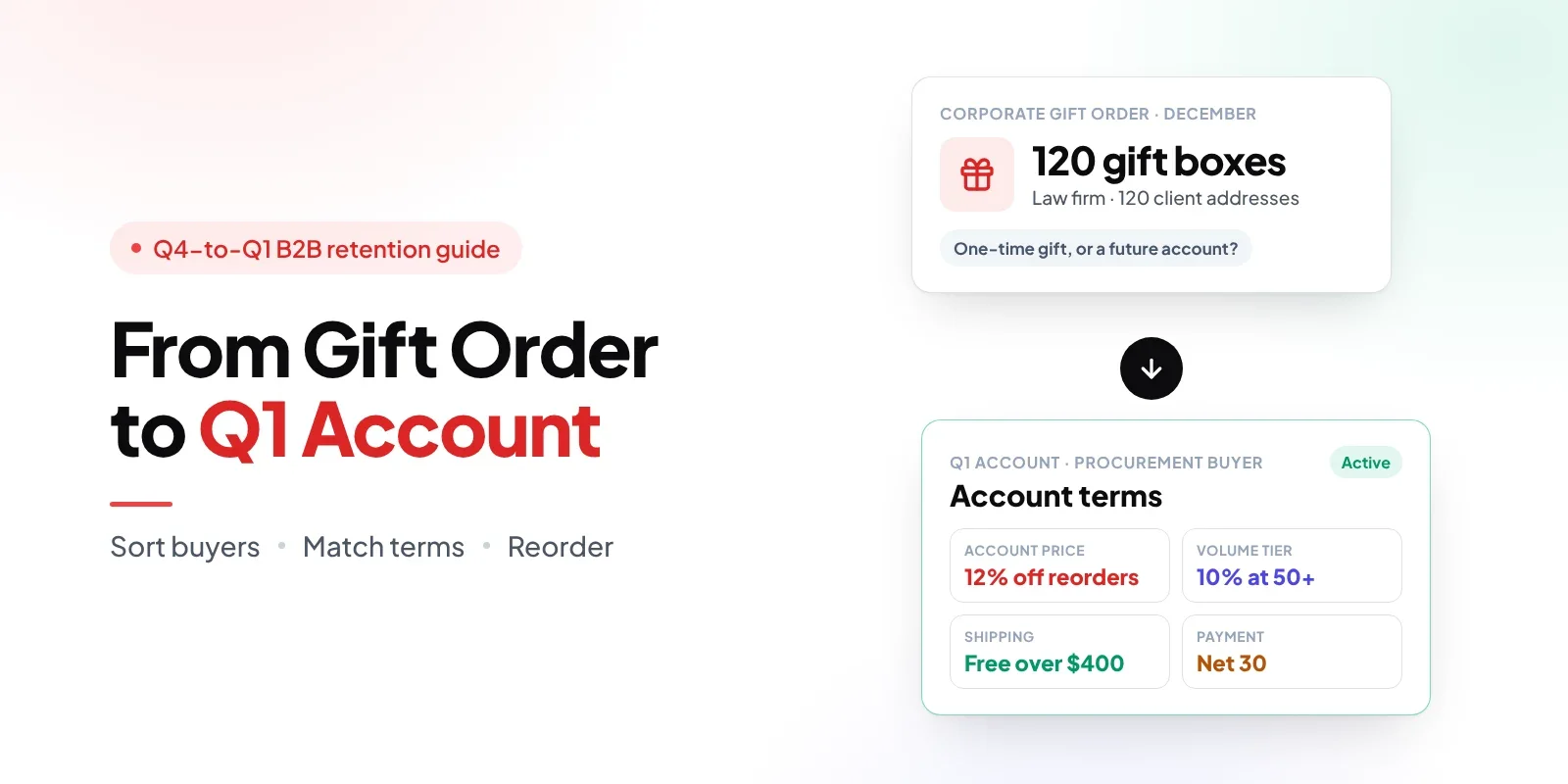
It's mid-December and you've packed 47 business orders this season. A law firm ordered 120 gift boxes for clients, a dental group sent 30 to its staff, and a hotel bought a case of your product for its rooms. Someone on your team asks the obvious question: "Should we offer all of them wholesale pricing in January?"
That's the moment most stores get corporate gift buyers wrong. Some treat every business order as seasonal money and never follow up. Others hand the whole list a standing discount and net terms, which gives away margin to people who were only ever going to buy once. Both mistakes are expensive, because corporate orders are large and the few buyers who would reorder are worth far more than a single December box.
The upside is real, and so is the drop-off. One candle brand told Modern Retail that corporate gifting grew from about 7% to about 19% of its sales in a year, while its corporate re-order rate sat at about 18%. Most of that business doesn't come back by itself.
This guide treats B2B customer retention on Shopify as a sorting job. It shows you how to sort your Q4 corporate gift buyers into four types, which signals tell them apart, and which Q1 follow-up fits each one: account-specific pricing, volume thresholds, shipping benefits, or repeat-order terms.
Short answer: Sort your Q4 corporate gift buyers into one-time gifters, annual gifters, occasion gifters, and procurement buyers. Offer account-specific pricing and repeat-order terms only to buyers who buy for their own use or several times a year. Give annual gifters a reason to book next Q4 early, and give one-time gifters a simple, low-cost reason to remember you.
TL;DR
A corporate gift order is not an account. Most business gift buyers order once a year or once ever, and only a few have a real repeat pattern.
The Gift-to-Account Sort splits buyers into four types: one-time gifters, annual gifters, occasion gifters, and procurement buyers.
Order size, email domain, product type, shipping pattern, and one direct question tell you which type a buyer is.
Each type gets a different Q1 path: a reminder, an early-booking offer, volume thresholds with shipping benefits, or full account terms.
Shopify B2B now runs on Basic, Grow, and Advanced plans, and a discount app such as DiscountRay can apply tag, list, company, and order-history pricing to the buyers you've sorted.
Judge the result by second orders and margin per account in the first 90 days, not by how many accounts you opened.
Why Corporate Gift Orders Don't Turn Into Accounts on Their Own
Corporate gift orders don't turn into accounts on their own because the order says almost nothing about what the business will need next. The buyer is usually an office manager, executive assistant, or marketing coordinator spending someone else's budget on a once-a-year job. When the gifts ship, their task is done, and nothing in your store prompts them to think of you again until next autumn.
Several things make this harder than consumer retention:
The buyer isn't the user. Like consumer gift buyers whose orders don't reflect their own taste, a corporate buyer picked products for other people. Their order history is a poor guide to what they'll buy next.
The recipients aren't your customers. The 120 people who opened the law firm's boxes never gave you their details, and you can't market to them without consent.
The contact changes. The assistant who placed the December order may not own next year's budget, or may leave the company.
Your follow-up is built for consumers. Most stores send business buyers the same post-purchase emails and January sale code as everyone else, which feels off to someone buying on a company card.
That's why B2B customer retention after the holidays starts with sorting buyers, not with a discount. And there's a strong reason to follow up. Companies gift because it helps their own relationships: in a 2022 Business.com poll of 1,547 professionals, 46% of recipients said a vendor's year-end gift made them more likely to keep working with that vendor. A business that saw that effect has a reason to gift again, and some of them have reasons to buy from you between holidays as well.
The Gift-to-Account Sort: Four Types of Corporate Gift Buyers
The Gift-to-Account Sort is a simple way to group corporate gift buyers by how often they're likely to buy and why. Each type needs a different goal in Q1, and only one of them is ready for a corporate account from day one.
One-Time Gifter
A one-time gifter is a business that bought gifts once, for one occasion, with no sign it will repeat. Think of a small agency that sent 25 boxes to clients after a good year, or a team lead who ordered gifts for a retirement party. The goal in Q1 is to be remembered, not to sell them an account.
Annual Gifter
An annual gifter buys every Q4 for the same reason, usually client or employee holiday gifts. You may already see two or three December orders in their history. They're valuable but seasonal, so the goal is to secure next year's order early, not to push them into monthly buying they don't need.
Occasion Gifter
An occasion gifter buys gifts several times a year: new-hire welcome kits, client onboarding boxes, event swag, thank-you gifts after a deal closes, or Employee Appreciation Day. The December order is just the biggest one. The goal is to make every next order easier and cheaper per unit, which is where volume thresholds and shipping benefits fit.
Procurement Buyer
A procurement buyer purchases your product for the business to use, not to give away. A hotel stocking rooms, an office restocking its kitchen, a salon using your products, or a co-working space buying coffee every month are all procurement buyers, even if their first order arrived during gift season. The goal is a real account with account-specific pricing and repeat-order terms. Once you have a handful of these, they're the start of a corporate discount program.
Type | What they bought | How often they buy | Q1 goal |
|---|---|---|---|
One-time gifter | Gift sets for one event | Once | Be remembered for the next occasion |
Annual gifter | Holiday gifts for clients or staff | Every Q4 | Book next year's order early |
Occasion gifter | Gifts for several events | Several times a year | Make each next order easier and cheaper per unit |
Procurement buyer | Products the business uses | Monthly or quarterly | Open an account with agreed terms |
How to Spot Corporate Orders and Sort Them in Shopify
You spot corporate orders from signals in the order and the customer record, then confirm the type with one direct question. Shopify doesn't label an order as a corporate gift, so the sorting is your job.
Read the Signals in the Order
Look at these signals together, because no single one is decisive:
Signal | Points toward |
|---|---|
Company name filled in, business email domain | Any corporate type |
20 or more units of a gift set | Gifter (one-time, annual, or occasion) |
Many ship-to addresses or a recipient spreadsheet | Gifter |
Gift notes or branded inserts | Gifter |
Consumable or bulk products, not gift boxes | Procurement buyer |
PO number, invoice request, or tax-exemption question | Procurement buyer or occasion gifter |
A previous Q4 order from the same company | Annual gifter |
Orders in more than one season | Occasion gifter or procurement buyer |
Ask One Question
The fastest way to sort a buyer is to ask. Add one line to the thank-you email or invoice: "Is this a one-time gift, something you do every year, or something you order regularly?" Most business buyers answer, because the honest answer helps them get better terms. Record the answer as a customer tag.
Build Segments and Tags
Shopify customer segments can pull most of your corporate buyers into one list. The segment editor supports filters such as customer_email_domain, number_of_orders, amount_spent, first_order_date, and companies, so you can find customers with a non-personal email domain who spent over a set amount in Q4. Then tag each buyer with the season and the type, for example corp-gift-2026 plus corp-onetime, corp-annual, corp-occasion, or corp-procurement. Shopify Flow can add the first tag automatically when an order passes a quantity you choose, but the type tag works best after a person has reviewed it.
Four Q1 Follow-Up Paths for Repeat Corporate Orders
The four Q1 follow-up paths are account-specific pricing, volume thresholds, shipping benefits, and repeat-order terms. Each one costs you something different, so each one belongs with a different type of buyer.
Account-Specific Pricing
Account-specific pricing means one business gets its own price on the products it buys regularly. It suits procurement buyers, because their orders are predictable and their volume justifies a lower price. Keep it narrow: price only the products they reorder, not your whole catalog, and set a review date, such as the end of Q2. Prices with a review date are easier to adjust later, which matters when you're raising wholesale prices without losing accounts. For buyers who commit to a minimum volume over a year, contract-based discounts are the more formal version.
The limit is margin. Account pricing applies to every order the buyer places, including the ones they would have placed at full price, so it only pays when it wins volume you wouldn't otherwise get.
Volume Thresholds
Volume thresholds give a lower price per unit once an order reaches a quantity or spend level, for example 5% off at 25 boxes and 10% off at 50. They suit occasion gifters and annual gifters, because the discount only kicks in when the order is big enough to be worth it. Setting up tiered pricing for bulk orders for a business-only group of customers keeps those tiers away from retail shoppers. Spend-based rewards work the same way: milestone discounts that reward a spend goal can add free shipping or a free item at, say, $750.
The limit is that every buyer who crosses the tier gets it, so set the tiers above your typical corporate order, not at it.
Shipping Benefits
Shipping is often the cost corporate buyers notice most, especially when an order goes to many addresses. A shipping benefit, such as free shipping to one address above a spend level or a flat rate per recipient, can matter more to an occasion gifter than a percentage off. It also protects your product price. Shipping perks work well as one of several B2B membership perks for buyers who order more than once.
The limit is the true cost. Multi-address gift orders are expensive to pack and ship, so price the benefit from your real per-parcel cost.
Repeat-Order Terms
Repeat-order terms make reordering easy: payment terms such as Net 30, a saved reorder list, a standing monthly order, or a fixed delivery day. They suit procurement buyers almost exclusively. B2B buyers want this to be self-serve, too. In Sana Commerce's 2025 B2B Buyer Report, a survey of 750 buyers, 73% said they prefer buying online.
The limit is credit risk. Net terms mean you ship before you're paid, so offer them only to businesses with a few paid orders behind them, and cap the amount.
Show the Right Product Lines
The gift box a business bought in December is rarely what it needs in March. When you follow up, show each type the products that fit how they buy: refill sizes and bulk packs for procurement buyers, smaller welcome-kit items for occasion gifters, and the new season's range for annual gifters.
Which Path Fits Which Corporate Gift Buyer
Use this matrix to match each type to its Q1 path. Not every buyer belongs among your corporate gifting accounts, so the last column matters as much as the others.
Type | Account pricing | Volume threshold | Shipping benefit | Repeat-order terms | What to offer in Q1 | What not to offer |
|---|---|---|---|---|---|---|
One-time gifter | No | No | No | No | A thank-you, an occasion reminder, a single-use code for their next business order | Standing discounts or net terms |
Annual gifter | No | Yes, for next Q4 | Optional | No | An early-booking offer for next Q4 | Year-round account pricing |
Occasion gifter | Not yet | Yes | Yes | Not yet | Business-only volume tiers and a shipping benefit, valid through Q2 | Net terms before two or three paid orders |
Procurement buyer | Yes | Yes | Yes | Yes | A Shopify B2B company account with agreed prices, terms, and a review date | Prices with no end date |
An occasion gifter who orders three or four times by midsummer has shown you a pattern. That's the point to move them up to account terms, because repeat corporate orders are now part of how they buy.
Setting It Up With Shopify B2B (Native First)
Shopify now handles much of the account side without Shopify Plus. Since April 2, 2026, merchants on Basic, Grow, and Advanced plans can use company profiles, payment terms, quantity-based pricing, and up to 3 active B2B catalogs assigned through markets. Unlimited catalogs, direct catalog assignment to a company, deposits, and partial payments stay on Plus. B2B isn't available on the Starter or Retail plans.
Here's how the native tools map to the four paths:
Need | Native Shopify option | Watch out for |
|---|---|---|
Account-specific pricing | B2B catalogs with fixed prices or a percentage adjustment | Up to 3 active catalogs outside Plus, assigned through markets, not to one company directly |
Volume thresholds | Quantity price breaks and quantity rules in a catalog | Applies to everyone in that catalog |
Repeat-order terms | Payment terms (such as Net 30) set on a company location | Terms are fixed per location |
Quotes and large orders | Draft orders with an invoice | Manual, and best for one-off quotes |
Finding buyers | Customer segments and tags | You still decide the type |
Targeted offers | Discounts limited to specific customers, segments, or B2B markets | Retail discounts can reach B2B buyers if eligibility is left open |
Two other limits matter for gift-heavy stores. Shopify B2B doesn't work with subscriptions, accelerated checkouts, or local delivery, and gift cards at checkout are off by default for B2B buyers. Plan around those before you move a buyer to a company account.
If three catalogs aren't enough, or you want pricing that reacts to order history, tags, or cart size, it helps to compare Shopify's native B2B volume pricing with a rules-based app. For one-time and annual gifters, you often don't need a company account at all. A discount limited by discount eligibility by customer, segment, or market is usually enough.
Where DiscountRay Fits, and Where It Doesn't
DiscountRay, a Shopify discount and B2B pricing app by EFOLI, fits after you've sorted your buyers. It applies the pricing side of each Q1 path to the customers you've tagged, listed, or set up as companies.
What it can do:
Tag and customer-group offers. On the Growth plan ($14 a month), you can target specific B2B customers and customer groups by tag, so a
corp-occasiontag can carry business-only volume tiers.Rules by company, list, and order history. On the Pro plan ($29 a month), the personalized discount uses "when → then" rules with AND/OR logic. Conditions include B2B company, customer list, customer tag, products, cart value, cart items, and order history, and rewards include a percentage, a fixed amount, a free gift, free shipping, or a shipping discount.
Tiered quantity discounts. On every plan, including the free Starter plan, you can set quantity tiers for selected products, collections, or the whole store.
Milestone offers. Spend or quantity thresholds that trigger a discount, free shipping, or a free gift, which suits occasion gifters.
Single-use codes tied to one buyer. A personalized code only works for the email it was issued to and can't be reused, which is a clean way to give a one-time gifter a reason to return without creating a public code.
End dates. Scheduled start and end dates keep Q1 offers from turning into permanent prices.
What it doesn't do: DiscountRay doesn't identify corporate buyers for you, and it doesn't create Shopify companies, catalogs, or payment terms. It doesn't send invoices, handle quotes or purchase orders, manage multi-address shipping, or print gift messages. Use Shopify B2B, draft orders, and your shipping setup for those, and use DiscountRay for the discount and pricing rules on top.
A Worked Example: 52 Corporate Orders, Four Q1 Plans
Here's an illustrative example. A specialty chocolate shop on Shopify's Grow plan took 52 corporate orders in Q4 2026. After reading the signals and asking the one question, the owner sorted them like this:
Type | Buyers | Typical Q4 order | Q1 plan |
|---|---|---|---|
One-time gifter | 31 | 25 boxes, about $900 | Thank-you note, a $25 single-use code on a business order over $300, valid to March 31, and a reminder before Employee Appreciation Day |
Annual gifter | 11 | 60 boxes, about $2,280 | Book next Q4's order by September 30 for 5% off and a fixed ship date |
Occasion gifter | 7 | 40 boxes, about $1,500 | Business-only tiers (5% at 25 boxes, 10% at 50) and free shipping to one address over $750, January 15 to June 30 |
Procurement buyer | 3 | Monthly restock, about $600 | Company account with 12% off reordered items, free shipping over $400, Net 30, prices reviewed June 30 |
Take one procurement buyer, a boutique hotel that stocks your chocolates in its rooms. At a 55% gross margin, a $600 order earns $330. The 12% account price costs $72 per order, which leaves $258 in gross profit on $528 of revenue, a margin of about 49%. If the hotel orders monthly for six months, that's about $1,548 in gross profit from a buyer who would otherwise have looked like a single December order. Working out margin after a discount this way before you offer account pricing keeps the terms honest.
Now take the annual gifters. A 5% early-booking discount on a $2,280 order costs $114. It doesn't create a new order, but it locks in one you'd otherwise have to win again next November, and it gives you a firm production date.
The owner tags each group, sets the occasion tiers and the procurement pricing as tag-based rules in DiscountRay, sets up the three procurement buyers as companies with Net 30 terms in Shopify, and sends the single-use codes to the one-time gifters.
A Q1 Calendar for Corporate Gift Buyers
Timing matters because business buyers plan around budgets and occasions, not sale dates. Here's a simple calendar that fits the January-to-March stage of a Q4-to-Q1 holiday retention plan.
When | What to do |
|---|---|
December | Capture company names, contacts, and the one-question answer on every corporate order |
January 5 to 16 | Send a thank-you, check delivery went well, and finish sorting buyers |
January 19 to 30 | Invite procurement buyers to an account and send occasion gifters their tiers |
February | Remind one-time and occasion gifters before Employee Appreciation Day (Friday, March 5, 2027) |
March | Review second orders, margin, and which occasion gifters are ready for account terms |
August to September | Send annual gifters their early-booking offer and book production slots |
Keep January messages to business buyers separate from your consumer January sale. New Year follow-up offers for retail customers usually lead with a discount, while business buyers respond better to terms, timing, and convenience.
How to Measure Whether It Worked
Measure the outcome you wanted from each type, not the number of accounts you opened. Track these five numbers for the 90 days after your first Q1 message:
Second-order rate by type: the share of each group that placed another order.
Account conversion rate: procurement and occasion buyers who accepted account terms and then ordered.
Gross margin per account: revenue after account pricing, minus product and shipping cost.
Days to second order: a shrinking gap is a sign the terms made reordering easier.
Early-booking rate: annual gifters who booked next Q4 by your deadline.
If you have enough buyers in a group, keep a few out of the offer as a holdout group to measure incremental revenue. Don't hold out procurement buyers who already have agreed terms, because their prices aren't a test.
Common Mistakes
Giving every corporate gift buyer wholesale pricing. It feels generous, but one-time gifters take the discount and don't come back, and it becomes hard to explain why your real accounts pay the same.
Sending business buyers your consumer flows. A buyer on a company card doesn't want a "We miss you, here's 15% off" email. Send a short, practical message about their next occasion or their account.
Emailing gift recipients without consent. The recipients of a corporate gift didn't sign up for your list. If you want to reach them, use an insert with an opt-in, not their shipping addresses.
Offering net terms too early. Net terms after one order is extending credit to a stranger. Wait for a few paid orders and set a limit.
Leaving prices open-ended. An account price with no review date becomes permanent. Put an end date or review date on every account term.
Letting retail discounts reach B2B orders. Since June 23, 2026, B2B discounts are on by default for new and eligible existing B2B stores, and discounts set to all customers can apply to business buyers unless you assign markets. The same rules that apply to keeping retail sale discounts off wholesale prices apply here.
Keeping one contact per company. If the only contact is the assistant who placed the December order, you lose the account when they move on. Ask for a second contact or the budget owner when you open an account.
Conclusion
Corporate gift buyers aren't one group. Most are one-time or annual gifters who need a reminder or an early-booking offer, a few are occasion gifters who reward easier volume pricing and shipping, and a small number are procurement buyers worth a real account. The Gift-to-Account Sort helps you tell them apart before January, so each buyer gets the follow-up that fits.
Start with the signals and one question, tag every business buyer by type, and match each type to its Q1 path. Give account-specific pricing and repeat-order terms only where there's a repeat pattern, put an end date on every offer, and judge the results by second orders and margin per account. Repeat corporate orders rarely come from one big January discount. They come from the right terms for the right buyer, and that's how a December gift order becomes a business that buys from you all year.
How do I get repeat orders from corporate gift clients?
Should corporate gift buyers get wholesale pricing?
Is Shopify B2B available without Shopify Plus?
Can I offer Net 30 terms to a business customer on Shopify?
How do I find corporate orders in my Shopify store?
When should I follow up with a corporate gift buyer after the holidays?
What discount should I give a corporate buyer for a second order?
Can I limit a discount to one company's employees?
Do Shopify discounts apply to B2B orders?
Does DiscountRay set up Shopify B2B companies or payment terms?

Syeda Rehnoma Tanzom
This article is written by Syeda Rehnoma Tanzom, an SEO content writer with 3+ years of experience specializing in eCommerce content. What makes the work here a little different? A close collaboration with support teams to understand what merchants are actually going through, their frustrations, their questions, and their wins. The goal is simple: write content that speaks to real problems, not just search engines. When not buried in keywords and content briefs, you'll find her nose-deep in a good book, binge-watching true crime documentaries or psychological thrillers, and occasionally switching gears with a feel-good rom-com.
この記事はDiscountRayのテクニカルサポートチームが確認しています。同チームは、割引の設定、対象顧客の条件、カートの挙動、チェックアウト時の割引に関する問題のテストを日常的にShopifyマーチャントと行っています。