Shopify B2B volume pricing is now available on Basic, Grow, and Advanced plans. It is a strong starting point for merchants running a straightforward wholesale operation. Company profiles, payment terms, and catalog-based volume pricing are no longer a Shopify Plus exclusive. It is worth understanding clearly before deciding whether a third-party app still belongs in your stack.
The limits of native B2B volume pricing become more visible when your pricing depends on more than three buyer tiers, when you need to price by customer tag rather than catalog, or when your wholesale strategy rewards buyers based on their order history over time. That is where B2B volume pricing and DiscountRay stop overlapping and start solving different problems. This post explains both sides honestly so you can decide which one your setup actually needs.
As of April 2, 2026, company profiles, B2B catalogs, and volume pricing are available on Basic, Grow, and Advanced Shopify plans at no extra cost. Previously, these features required a Shopify Plus subscription starting at $2,300 per month. That is a meaningful change for merchants who have been running wholesale through workarounds.
Here is how the native setup works. You create a company profile for each wholesale buyer, then build a catalog that defines their pricing. Inside that catalog, you can set up to 10 volume price breaks per product, applied at the variant level. A buyer ordering 10 units of a product sees one price; a buyer ordering 50 units sees a lower one. The pricing displays automatically on the product page when that buyer is logged in, and payment terms like Net 30, Net 60, and Net 90 can be set at the company level.
For a merchant with two or three wholesale accounts and clean, predictable pricing tiers, this is a genuinely capable setup with no additional monthly cost.
This update removes the entry barrier for foundational wholesale on Shopify. Before April 2, 2026, accessing native B2B tools meant committing to Shopify Plus. Now, merchants on Basic, Grow, and Advanced plans get company profiles, payment terms, volume pricing, vaulted credit cards, ACH payments in the US, and up to 3 active B2B catalogs, all included in their existing plan.
For merchants just starting with wholesale, or running a small number of accounts with consistent pricing, this is a practical starting point that does not require a third-party app or a platform upgrade. The question worth asking is whether your wholesale pricing strategy fits within the structure that native B2B catalogs are built around, or whether it needs to go further
The catalog architecture that makes Shopify volume discounts work is also what defines its limits.
On Basic, Grow, and Advanced plans, you can assign up to 3 active catalogs across all your B2B markets. That cap applies across all markets combined, not per market. Three catalogs means three pricing tiers. If you need a fourth, the native path is Shopify Plus.
The second limit is structural. Volume pricing in native B2B applies at the variant level. A buyer needs to purchase the required quantity of a specific variant to qualify for the price break. A buyer ordering 15 blue hats and 10 grey hats does not combine those quantities to hit a 25-unit threshold. Each variant is evaluated independently. Cart-level discount logic has no native mechanism in Shopify B2B on non-Plus plans.
Two further limits are worth knowing before setting up:
DiscountRay does not use the catalog-market architecture. Pricing logic is built around customer tags, behavior rules, and discount conditions. It approaches Shopify B2B volume pricing from a different angle entirely.
The core features relevant to B2B pricing:
| Feature | Shopify Native B2B | DiscountRay |
|---|---|---|
| Volume price breaks | Yes, up to 10 price breaks per product | Yes, volume and tiered discounts |
| Pricing model | Catalog-based | Rule and tag-based |
| Customer segmentation | Up to 3 active catalogs on non-Plus plans | Customer groups and tags |
| Variant-level pricing | Yes | Yes |
| Cart-level discounts | Not available on non-Plus plans | Yes |
| Same flexible discount rule for B2B + B2C | Limited to catalog-based B2B pricing | Yes, discount rules can target different customer groups |
| Order-history-based offers | Not part of native B2B catalogs | Available through milestone discount rules (Pro plan) |
| Personalized pricing by behavior | Not part of native B2B catalogs | Yes (Pro plan) |
| Company profiles | Yes | Not required |
| Payment terms (Net 30/60/90) | Yes | Not applicable |
| Cost | Included in Shopify plan | Free plan available; paid plans from $9/month |
Features verified against Shopify Help Center documentation and DiscountRay’s App Store listing and changelog as of June 2026.
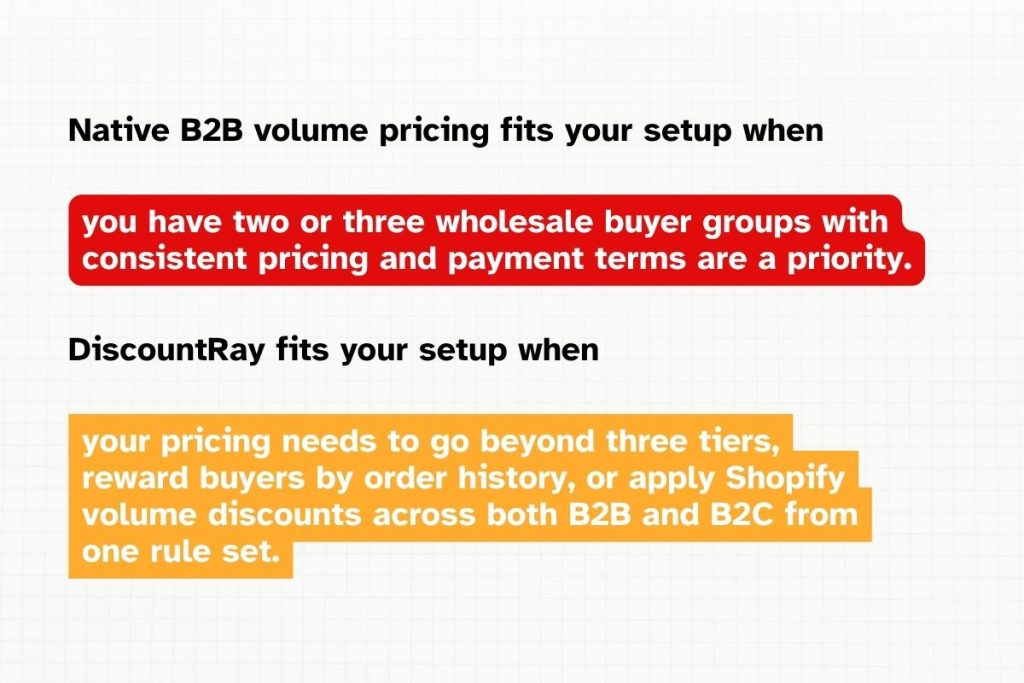
Native B2B volume pricing fits your setup when you have two or three wholesale buyer groups with consistent, predictable pricing, company profiles and payment terms are a priority for your wholesale workflow, and your buyers order enough of the same variant to trigger per-variant price breaks. If that describes your operation, the native setup covers the basics well and costs nothing beyond your existing Shopify plan.
DiscountRay fits your setup when your pricing strategy needs to go beyond three tiers, you want to reward buyers based on their cumulative order history rather than just what they are buying today, or you need volume discounts running across both B2B and B2C buyers from the same rule set without managing separate catalog structures. It is also the better fit for merchants who want personalized pricing based on customer location, cart value, or buyer behavior, conditions that native Shopify B2B catalogs do not support below Plus.
If you are already using DiscountRay, the Spring ’26 update does not replace what it does. Native B2B volume pricing is catalog-based and assigns the same price to every buyer in a catalog. DiscountRay is customer-aware. If milestone pricing or tag-based segmentation is part of how you manage wholesale relationships, native B2B is a structurally different tool, not a replacement.
Yes, and for some merchants that combination makes sense. Shopify’s native B2B handles company profiles, catalog assignment, and payment terms, the structural side of a wholesale relationship. DiscountRay handles the pricing logic that catalogs do not support, such as milestone rewards or personalized rates for specific buyer segments.
One thing to test before running both on the same products: once volume pricing is applied to a product inside a native catalog, the overall catalog-level discount no longer applies to that product. If you are layering DiscountRay discounts on top, verify the discount behavior at checkout before going live, since native volume pricing and app-based discounts can interact in ways that need to be confirmed per setup.
Shopify’s native B2B volume pricing is a meaningful step forward for merchants who previously had no wholesale pricing option below Plus. For simple setups, two or three buyer tiers, catalog-based pricing, payment terms, it handles the foundations cleanly and costs nothing extra on top of your existing plan.
The limits become clear once your wholesale pricing needs to respond to buyer behavior, order history, or more than three customer segments. Native Shopify B2B catalogs are built for structure and consistency; DiscountRay is built for flexibility and customer-awareness. If your B2B strategy needs to reward buyers based on who they are and how they buy over time, not just how many units they order in a single transaction, DiscountRay’s milestone and personalized discount features are where native B2B volume pricing stops and a more capable setup begins. You can install DiscountRay and start with the free plan to test volume and tiered discounts before moving to the features that go further.
Yes. As of April 2, 2026, B2B volume pricing is available on Basic, Grow, and Advanced Shopify plans at no extra cost. You can set up to 10 price breaks per product, applied at the variant level, within a B2B catalog assigned to a market.
Once volume pricing is applied to a product inside a catalog, the overall catalog-level discount no longer applies to that product. The volume price becomes fixed, and the two discount types do not combine on the same item.
Not natively. Customer-tag-based pricing is not available in Shopify’s native B2B features on non-Plus plans. If you need tag-based segmentation, giving different pricing to different buyer groups based on a tag, you need a third-party app like DiscountRay.
Volume pricing reduces the unit price based on how many items a buyer orders in a single transaction. A milestone discount responds to a buyer’s cumulative order history, a buyer who has placed multiple orders over time qualifies for better pricing based on that track record, regardless of the quantity in any single order.
No. Shopify B2B volume pricing is catalog-based pricing built specifically for B2B buyers assigned to company profiles. A volume discount app typically gives merchants more flexible conditions, customer tags, cart value, product groups, location, scheduled promotions, or mixed B2B and B2C discount rules. Shopify’s native setup suits structured wholesale catalogs; a discount app suits flexible promotional logic that needs to adapt to different customer types and behaviors.
Yes. The two can coexist, native B2B handles company profiles and payment terms, while DiscountRay manages pricing logic that catalogs do not support. If you run both on the same products, test the discount behavior at checkout before going live, since native volume pricing and app-based discounts can interact in ways that need to be verified per setup.

This article was reviewed by the DiscountRay Technical Support Team, who regularly helps Shopify merchants test discount setup, customer eligibility, cart behavior, and checkout-related discount issues.
Get started with our free plan or unlock premium features with a 14-day free trial.
30-day money-back guarantee!



 English
  日本語
日本語  Français
  Deutsch
  Español
  简体中文
简体中文  Italiano