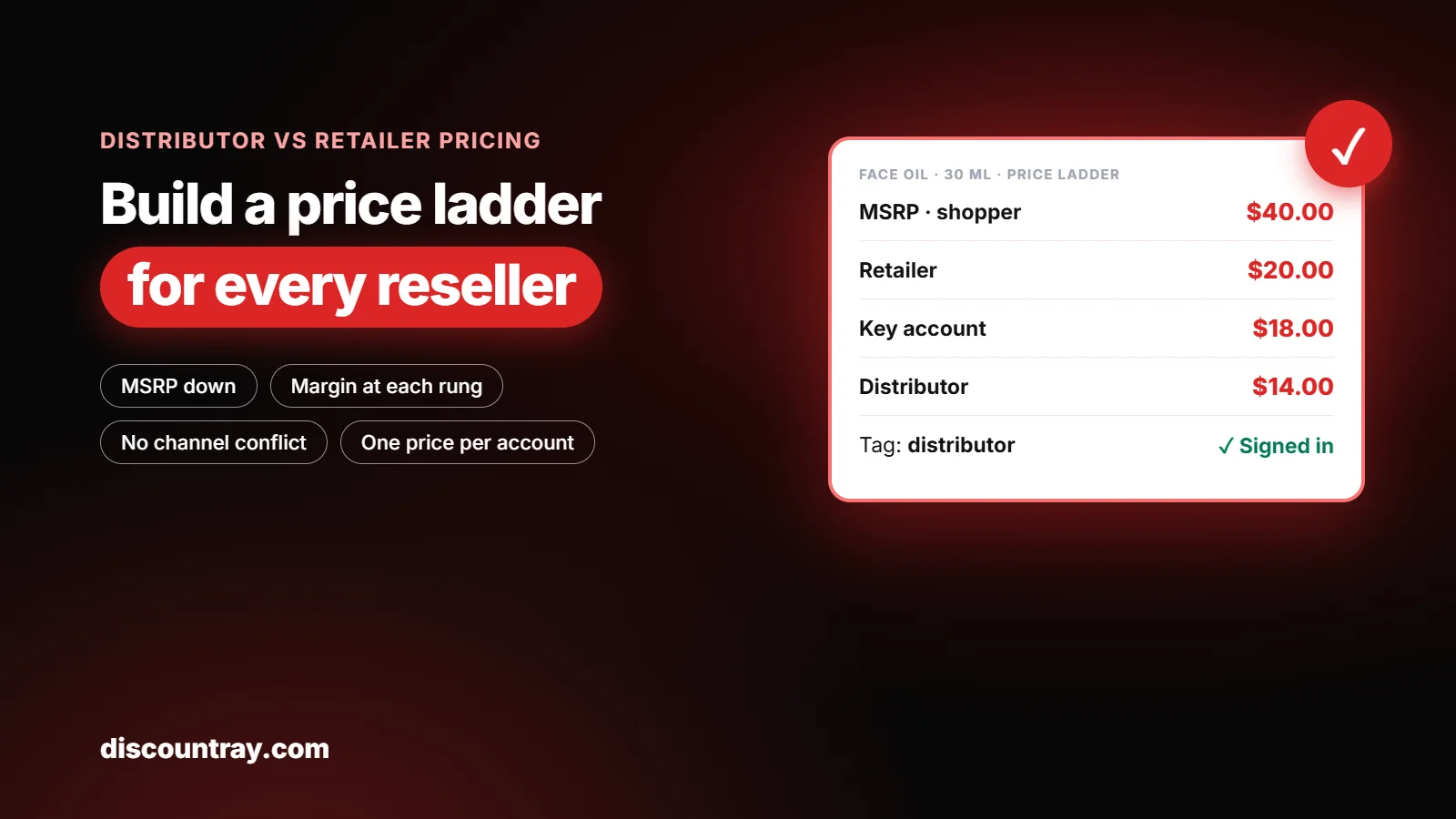
Distributor pricing works when you build a price ladder from your retail price down: retailers buy at one price, distributors buy at a lower price because they resell to retailers, and each step leaves the next reseller enough margin to do their job. Build the ladder on paper first, then give each account type its own price in Shopify, so a retailer never sees the distributor price and nobody can buy from you for less than your distributor sells for.
This guide shows how to build that ladder with real math, the three leaks that cause channel conflict, how MSRP and minimum advertised price rules fit in, and how to set the ladder up in Shopify.

Distributor price ladder from MSRP down to distributor price, with the margin at each step
Key takeaways
A price ladder has at least three rungs: MSRP, retailer (wholesale) price and distributor price. Many brands add a key account rung.
Work from the top down. Start with what the shopper pays, then give each reseller the margin they need.
The distributor price must sit below the retailer price by at least the distributor’s margin. If it doesn’t, the distributor can’t sell to retailers.
Channel conflict usually comes from three leaks: quantity tiers that reach the distributor price, small retailers getting distributor prices, and resellers selling to shoppers below MSRP.
MSRP is a suggestion. The FTC says dealers are free to set their own prices, though a manufacturer can choose not to deal with dealers who don’t follow its policy. Check your local rules, because some states and countries treat minimum resale prices differently.
In Shopify, B2B catalogs or a pricing app keep each rung visible only to the right accounts. Outside Plus, Shopify allows three active catalog assignments.
The phone call that starts with “Why is your distributor cheaper than you?”
A retailer calls on a Monday morning. She’s stocked your products for two years. Last week, a new shop opened across town carrying your full range, and its shelf price is lower than what she pays you wholesale.
The new shop buys from your distributor. Your distributor got a great deal because they take whole pallets. Somewhere between your price list and their sales team, that pallet price turned into a shelf price that undercuts your own retailer.
Nobody did anything dishonest. The prices just weren’t built as a ladder. Each one was set on its own, for its own reason, and nobody checked how they fit together. This post is about checking that before the phone rings.
Who sits on which rung
Before any numbers, be clear about who buys from you and what they do with the product.
Account type | Who they are | Who they sell to | What they need from your price |
|---|---|---|---|
Shopper | The end customer | Nobody | A fair retail price (MSRP) |
Retailer | Shops, salons, cafés, online stores | Shoppers | Enough margin to cover rent, staff and markdowns |
Key account | Large retailers or chains | Shoppers | A better price for large, regular orders |
Distributor | A business that stocks your products and sells them on to retailers | Retailers | A price low enough to resell to retailers at your retailer price and still profit |
The difference between a distributor and a big retailer isn’t size. It’s who they sell to. A chain of 40 shops that sells to shoppers is a key account. A two-person business that sells your products to 200 independent shops is a distributor.
How to build a price ladder, from the top down
The most common mistake is to start from your cost and add a markup for each channel. That tells you what you’d like to earn, not what the market can bear. Start instead from the shelf price and work down.
Here’s a worked example for a skincare brand selling a face oil. The numbers are made up, but the method works for any product.
Rung | Price | Margin for this reseller | How we got it |
|---|---|---|---|
MSRP (shopper pays) | $40.00 | Set by the brand | |
Retailer price | $20.00 | 50% for the retailer | MSRP × 0.50 |
Key account price | $18.00 | 55% for the retailer | Retailer price less 10% |
Distributor price | $14.00 | 30% for the distributor | Retailer price × 0.70 |
Brand’s landed cost | $7.00 | 50% for the brand at distributor price |
The distributor buys at $14 and sells to retailers at $20. Their margin is $6 on $20, or 30%. The retailer buys at $20 and sells at $40, keeping 50%. And the brand still earns $7 a unit at the lowest rung.

Margin at each rung of a distributor price ladder for a $40 product
The three checks every ladder must pass
Can the distributor resell at your retailer price and still earn their margin? Distributor price ≤ retailer price × (1 − distributor margin). In the example: $20 × 0.70 = $14. Pass.
Do you still make money at the lowest rung? Distributor price > landed cost, with enough left over for your overheads. $14 against a $7 cost. Pass.
Is the key account price above the distributor price? If a chain can buy from you for less than your distributor pays, you’re competing with your own distributor. $18 is above $14. Pass.
If any check fails, you have three levers: raise MSRP, lower your cost, or narrow one of the margins. Change one at a time and re-run all three checks.
Margin vs markup: the mistake that breaks ladders
Margin is profit as a share of the selling price. Markup is profit as a share of the cost. A 50% margin equals a 100% markup. If your distributor asks for “30%” and you hear markup while they mean margin, your ladder is off by several dollars a unit. Always write down which one you mean.
Selling price | Cost | Profit | Margin | Markup |
|---|---|---|---|---|
$20.00 | $14.00 | $6.00 | 30% | 43% |
$40.00 | $20.00 | $20.00 | 50% | 100% |
The three leaks that cause channel conflict
A ladder that’s correct on paper can still leak in practice. These are the three leaks we see most often.

Three causes of channel conflict between distributor and retailer prices
Leak 1: Quantity tiers that reach the distributor rung
Say you offer retailers a volume break: 10% off at 50 units, 20% off at 100, 30% off at 200. On a $20 retailer price, 30% off is $14, which is your distributor price. Any retailer who orders 200 units now buys at the distributor rung, without the distributor’s job of reselling and delivering to other shops.
Fix: Cap retailer volume breaks above the key account price. In the example, the deepest retailer tier should stay at $18 or higher. Quantity breaks and account tiers are different tools, and they shouldn’t overlap.
Leak 2: Small retailers on distributor prices
This one usually starts as a favor. A retailer asks for “the best price you have,” a salesperson says yes, and the retailer gets tagged as a distributor. A year later, that shop is undercutting its neighbors, and nobody remembers why.
Fix: Write down what makes an account a distributor (for example, they resell to at least ten other shops, hold stock, and order by the pallet) and review distributor accounts twice a year.
Leak 3: Resellers selling to shoppers below MSRP
A distributor with spare stock lists it on a marketplace below MSRP. Your retailers see it and lose sales. This is the hardest leak to fix, because it involves how other businesses set their own prices.
Fix: Start with clear agreements, sensible allocation and good communication. If you’re considering a pricing policy, read the next section first.
MSRP and minimum advertised price: what the rules say
This is where brands need to be careful. We’re not lawyers, and this isn’t legal advice, but the public guidance is a good starting point.
The FTC’s page on manufacturer-imposed requirements makes four points worth knowing:
Under federal law, manufacturer-imposed price programs are judged under a “rule of reason” approach, meaning their benefits are weighed against any harm to competition.
A manufacturer’s suggested retail price is a suggestion. Dealers may set their own prices, though a manufacturer may choose not to deal with dealers who don’t follow its policy.
Manufacturers have “considerable leeway” over the terms of advertising they help pay for, but there are limits. The FTC has challenged minimum advertised price policies that went too far.
Some state laws and authorities outside the US treat minimum resale price rules as illegal on their own.
What this means in practice: a brand can publish an MSRP, can set a minimum advertised price policy, and can decide who it sells to. A brand should not agree with resellers to fix prices, and it should get legal advice before enforcing any pricing policy, especially across borders.
Quantity breaks vs account tiers
These two get mixed up all the time, and the mix-up is where Leak 1 comes from.
Account tiers | Quantity breaks | |
|---|---|---|
What sets the price | Who the buyer is | How much they order |
Example | Retailer $20, key account $18, distributor $14 | 5% off from 50 units for retailers |
Changes when | You move an account to a new tier | The cart reaches a quantity |
Should overlap? | No, each tier has its own floor | Only within one tier, never down into the next |
The rule is simple: quantity breaks live inside a tier. A retailer can earn a few percent more off for a big order, but never enough to land on the key account or distributor rung.
What distributors expect besides price
A distributor’s margin pays for real work: holding stock, selling to shops you don’t reach, delivering, and often chasing payment. So distributors usually negotiate more than the unit price. Expect these questions in the first meeting:
Term | What they’ll ask | How it affects your ladder |
|---|---|---|
Minimum order | “Can we order by the case instead of the pallet?” | Smaller orders cost you more to ship, so a lower minimum may need a higher price |
Payment terms | “Can we have 30 or 60 days?” | Net terms tie up your cash; Shopify lists net terms on all B2B plans |
Freight | “Who pays shipping to our warehouse?” | Free freight is a hidden discount; count it in the distributor rung |
Territory | “Are we the only distributor in this region?” | Exclusivity is worth something, so link it to a sales target |
Marketing support | “Will you send samples and display units?” | Free stock and displays come out of your margin |
Price protection | “What happens to our stock if you raise or lower prices?” | Agree a notice period, and what happens to stock they already hold |
Write the answers into a short distributor agreement before the first order. Price is easier to hold when everything around it is clear.
What each account should see
A ladder only works if each account sees its own rung and nothing else. Check what each type of buyer sees at three points:
On your website. Retail shoppers see MSRP. Logged-in retailers see their price. Distributors see theirs. Nobody should see a rung below their own, even by accident in a cart or a quick-order form.
On your line sheet. Make one line sheet per rung. A distributor’s line sheet shows their price and the MSRP. A retailer’s shows the retailer price and the MSRP. Never send one sheet with every rung on it.
In your emails and invoices. Draft orders and invoices show the price charged. If your team copies an old invoice to make a new one, check the price before it goes out.
Showing MSRP to resellers is useful. It tells them where you expect the product to sit on the shelf, and it reminds them of their margin. Just make sure it’s labeled as a suggested price.
When a distributor asks for a bigger discount
It will happen, often after the first good season. Before you say yes or no, run the request through the ladder:
Put the new price into the three checks. A lower distributor price always passes the first check. The real test is the second: after freight, terms and support, do you still make money at the new price?
Ask what you get in return. A larger minimum order, a longer commitment, a new region or faster payment are all fair trades for a lower price.
Check what it does to key accounts. If the distributor price drops, is the gap to the key account price now big enough that chains will ask to buy through the distributor instead of from you?
Put it in writing, with a review date. “This price applies to orders of a full pallet until 31 December 2027” is easier to revisit than an open-ended discount.
A smaller discount tied to a bigger commitment is often better for both sides than a bigger one with no strings attached.
Where online retailers fit on the ladder
Online-only retailers sit on the retailer rung, but they cause more ladder trouble than shops, because their prices are public and easy to compare. A shop that sells below MSRP is seen by its town. An online store that does it is seen by everyone, including your other retailers.
Three habits help:
Price them like any retailer. Don’t give online stores a lower rung because they sell more units. If they grow large enough, move them to the key account rung, which has its own floor.
Share your MSRP and any advertising policy in writing before the first order, so expectations are clear from the start.
Watch for stock moving between channels. If a distributor’s retailer is really an online store selling nationwide, it may be selling into territory you serve directly. Ask before you assume.
Marketplaces follow the same logic. Decide who, if anyone, may sell your products there, and at which rung they buy.
Setting up the ladder in Shopify
Once the ladder works on paper, you need each account to see only its rung. You have three main ways to do that.
Method | How it works | Good fit | Watch out for |
|---|---|---|---|
Shopify B2B catalogs | A catalog per rung, assigned to companies in a B2B market | Brands on plans with B2B and a simple ladder | Outside Plus, three active catalog assignments in total |
Customer tags plus a pricing app | Tag each account “retailer,” “key-account” or “distributor”; the app prices by tag | Brands on any plan, or with more than three rungs | Tags need an owner, or Leak 2 creeps in |
Draft orders | Custom prices on a one-off order | Rare, large deals | Hard to keep consistent at scale |
Shopify’s B2B features by plan page says Basic, Grow and Advanced allow up to three active catalog assignments across active B2B markets, and that the limit is counted per market. One catalog assigned to two markets uses two of the three. Direct company catalogs are Plus only. If your ladder has retailer, key account and distributor rungs in two countries, that’s six assignments, so plan for it.
Inside each catalog, Shopify’s B2B catalogs guide explains that you can set an overall percentage adjustment or fixed prices per variant, and fixed prices override the percentage. Shopify’s quantity rules guide adds that you can set up to 10 price breaks per product, and that once volume pricing is applied, the price becomes fixed and the catalog’s overall adjustment no longer applies to it.
How to set up a distributor price ladder with DiscountRay
DiscountRay sets customer-specific prices without changing your base product prices, which suits a ladder where MSRP stays on the product and each rung is a rule on top. Here’s how we’d set up the face oil example. Check the app’s own help pages for the exact clicks.

Set up a distributor and retailer price ladder in DiscountRay in six steps
Keep MSRP as the product price in Shopify, so retail shoppers pay $40.
Tag each wholesale account with its rung: retailer, key-account or distributor. Pricing by customer tag and customer group is on the Growth plan, according to the DiscountRay App Store listing.
Create one price rule per rung. 50% off for retailers, 55% for key accounts, 65% for distributors, giving $20, $18 and $14.
Add quantity breaks inside the retailer rung only, and cap them so the deepest break stays above $18.
Use company or customer-list pricing for exceptions, such as one distributor with a negotiated price. Company and customer-list pricing are on the Pro plan.
Use country targeting for regional distributors if each distributor covers a different market. Country targeting is on the Pro plan.
At the time of writing, Growth is $14 a month and Pro is $29 a month, both with a 14-day free trial, and the free Starter plan covers quantity discounts for all customers. Check the listing for current prices.

DiscountRay customer-specific B2B pricing set up for a customer list
If you’re moving from another pricing app to set this up, our guide to a Bold Custom Pricing alternative covers how to map old price groups to new rules without breaking checkout.
A worked example: adding a first distributor
Here’s how the face oil brand adds its first distributor without upsetting its 35 retailers.
Before: The brand sells directly to 35 independent retailers at $20. A distributor offers to take the brand to 150 more shops in a region the brand doesn’t reach.
The ladder: $40 MSRP, $20 retailer, $18 key account (two chains), $14 distributor.
The territory question: Three of the brand’s 35 retailers are in the distributor’s region. The brand decides to keep serving those three directly at $20, and tells the distributor so in writing.
The setup: The distributor is tagged “distributor” and gets the $14 rule. The retailers’ volume break is capped at 10% off at 48 units, giving $18, the same as the key account rung and well above $14.
The note to retailers: “We’re working with a regional distributor to reach shops we can’t serve ourselves. Your prices and terms with us don’t change.”
Six months later: The distributor has opened 60 new shops, all buying at $20 from the distributor. The brand’s own retailers still pay $20. Nobody is undercutting anybody, because the ladder was built before the first pallet shipped.
Reviewing the ladder once a year
Ladders drift. Costs rise, a distributor asks for more margin, a retailer grows into a chain. Once a year, re-run the three checks from earlier with your current numbers:
Does every rung still leave the next reseller their margin?
Is your landed cost still well below the distributor price?
Has any retailer grown into a key account, or any account been tagged a distributor without doing a distributor’s job?
Keep the whole ladder on one page: each rung, its price, the margin it leaves, and the accounts on it. When a salesperson wants to make an exception, that page shows at a glance which rung the exception would break.
If you need to raise prices across the ladder, move every rung together, and give each account the same notice. Our guide to a wholesale price increase covers notice periods and how to protect chosen accounts. If you’re seeing odd prices at checkout already, our post on Shopify wholesale pricing problems lists the usual causes.
What DiscountRay doesn’t do here
It doesn’t decide your ladder. It applies the prices you set, so build and check the ladder first.
It doesn’t monitor prices on other websites or marketplaces. It controls prices in your Shopify store only.
It doesn’t write or enforce distributor agreements. Territory, allocation and pricing policies are contract matters.
It doesn’t approve trade accounts. You decide who gets each tag.
Ready to build your price ladder?
Write the ladder down, run the three checks, then give each rung its own rule in Shopify. If you want tag-based prices for retailers, key accounts and distributors, with company and country rules for the exceptions and no change to your base prices, try the customer-specific pricing app DiscountRay on its free plan or the 14-day trial.
Frequently asked questions
What is the difference between distributor and retailer pricing?
How much lower should a distributor price be than wholesale?
How do I stop retailers from getting distributor prices?
Can I make distributors sell at MSRP?
Can Shopify show different prices to retailers and distributors?

Anika Anamta Mehnaz
This article is written by Anika Anamta Mehnaz, a Content Writer and Content Marketing Strategist specializing in Shopify, eCommerce, and SaaS. With over four years of content writing experience, she creates SEO and AI search-optimized content that helps Shopify merchants make better business decisions through practical, research-backed insights. Her work covers Shopify apps, product variants, bundles, discounts, B2B commerce, and conversion-focused strategies. Outside of work, Anika enjoys watching anime, reading John Grisham novels, and discovering new ideas in digital marketing and e-commerce. If you enjoy discussing Shopify, content marketing, or online growth, feel free to connect with her. Twitter: https://x.com/mehnaz2201 Medium: https://medium.com/@mehnaz_78932
This article was reviewed by the DiscountRay Technical Support Team, who regularly helps Shopify merchants test discount setup, customer eligibility, cart behavior, and checkout-related discount issues.