It's the Monday after Cyber Monday. You have 900 new customers, three loyalty app demos in your inbox, and someone on your team saying, "We need a points program before January."
That's the moment most stores weigh a loyalty program vs targeted offers, and it's easy to pick the bigger, shinier option. A loyalty program is a long-term commitment: a monthly app fee, a reward budget on every eligible order, and someone to run it. It mostly rewards people who already come back. But your biggest gap right now is the first-time sale buyer who never places a second order.
That gap is wide. In Ometria's analysis of its retail clients, only 4% of Black Friday 2024 new customers made a repeat purchase within 12 months.
Here's the short version: most stores should start with targeted offers for specific groups after BFCM and add a loyalty program later, once repeat buying is common enough to reward. This guide compares the two side by side, gives you a five-question test to decide, and lays out a 90-day plan.
Short answer: Most Shopify stores don't need a full loyalty program right after BFCM. They need targeted offers that give specific groups, such as first-time BFCM buyers, repeat customers, and lapsed customers, a clear reason to place their next order. A loyalty program makes sense once customers already buy often, you have a meaningful base of repeat buyers, and you can fund and run rewards on every purchase.
TL;DR
A loyalty program rewards ongoing behavior for everyone who joins, while a targeted offer gives one chosen group one reason to act.
After BFCM, the biggest gap is the second order, and the points from one sale order usually aren't enough to redeem anything.
Loyalty programs fit stores where customers buy often, where there's a real base of repeat buyers, and where the team can fund and run rewards.
Targeted offers fit most stores in Q1, because they cost money only when the chosen group buys and they end on a set date.
Shopify doesn't include a built-in points program, but customer segments, tags, specific-customer codes, and store credit cover many targeted offers.
The safest path is offers now and a program later: run segment offers for 60 to 90 days, then decide with your own repeat data.
What's the Difference Between a Loyalty Program and Targeted Offers?
A loyalty program is a standing system that rewards customers for ongoing behavior, usually through points per purchase, VIP tiers based on spend, paid membership, or referral rewards. It's open to everyone who joins and runs all year, whether a given customer needed the nudge or not.
A targeted retention offer is a time-limited incentive aimed at a specific group of customers, defined by order history, tags, or behavior. It has one job, such as earning a second order, bringing back a lapsed customer, or thanking a high-value buyer, and it ends on a set date.
Put simply, the program is a system and the offer is a move. A program changes how every purchase feels over months. An offer changes what one group does next. Both are useful, and you can run both, but they solve different problems. Points, tiers, and referral rewards are all loyalty discount types that live inside a program, while a January "$10 off your second order" for BFCM first-timers is a targeted offer.
Loyalty Program vs Targeted Offers: The Side-by-Side Comparison
A loyalty program is better at raising purchase frequency among people who already buy from you. Targeted offers are better at triggering one specific next order from a group you choose. Here's how they compare on the things that matter to a small team.
Loyalty program | Targeted offers | |
|---|---|---|
Who it reaches | Everyone who joins | Only the group you choose |
Best at | Raising frequency among existing repeat buyers | Triggering one specific next order |
Time to pay back | Months, and it needs repeat buying to work | Weeks, measured per campaign |
What it costs | App fee, rewards on every eligible purchase, and upkeep | Reward cost only when the chosen group redeems |
Setup and upkeep | App, earning rules, rewards page, emails, support questions, outstanding points | One discount per group, with an end date |
Easy to stop? | No, removing points upsets members | Yes, offers end on their date |
Main risk | Paying rewards on purchases that would have happened anyway | Training customers to wait for a code |
What it needs | Frequent buying, a repeat base, margin, and an owner | Clean customer groups and discipline |
Loyalty Program vs Discounts: Why the Usual Comparison Misses the Point
Most pages that compare a loyalty program vs discounts set a points program against sitewide sales. That's a fair fight to lose for discounts, because blanket discounts are the weakest retention tool you have. Targeted offers are a different thing: they go to a defined group, for a defined job, with a defined end date, which is exactly how post-BFCM incentives that replace blanket discounts are meant to work.
What shoppers say they value supports a mixed approach. In Shopify's 2025 Global Holiday Retail Report, a Sapio Research survey of 18,000 shoppers in nine countries, 49% said discounts would earn their loyalty, 41% said free shipping and returns, and 29% said loyalty programs. Programs still matter to the people who use them: the 2026 Bond Loyalty Report found that 85% of the 20,591 U.S. loyalty program members it surveyed are more likely to keep doing business with a brand that has one. Note who was asked, though. Those are people already in programs, so the finding tells you programs work for engaged members, not that every store should launch one.
Why BFCM Changes the Decision
BFCM fills your customer list with people who bought once, at a discount, and have no habit with your brand yet. A loyalty program is built to reward a habit. Targeted offers are built to start one, which is why the post-BFCM moment usually favors offers first.
Ometria's data puts a number on the problem. Black Friday-acquired customers in its analysis were six times less likely to return than typical new customers. That doesn't mean BFCM buyers are worthless. It means the second order won't happen by itself, and whatever you do in January has to give these customers a concrete reason to come back.
The First-Order Points Gap
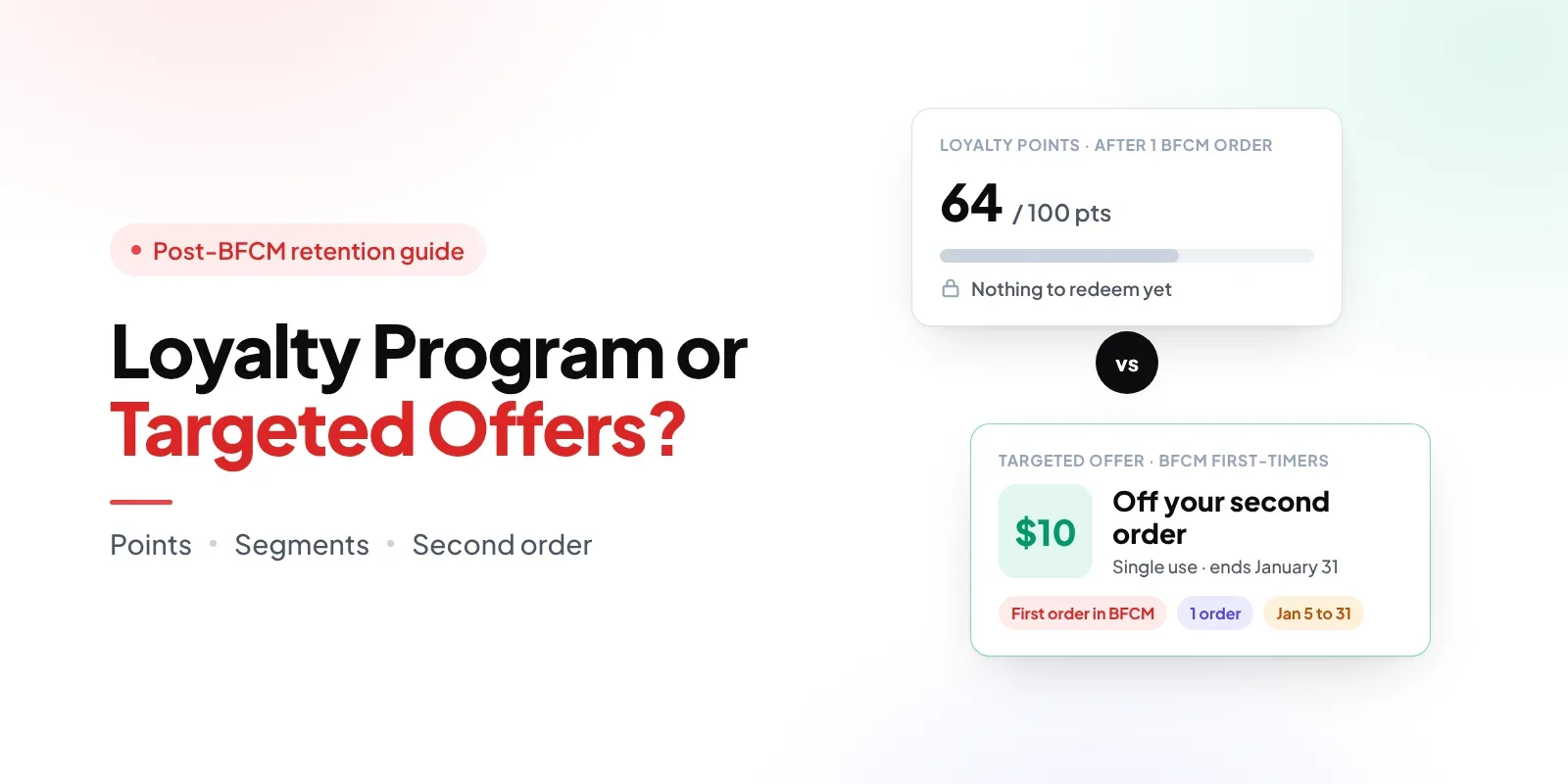
Here's the part most loyalty pitches leave out. Take a common points setup: 1 point per $1 spent, and 100 points earn a $5 reward. A BFCM customer who spent $64 has 64 points. That's not enough to redeem anything, so the program gives them nothing to act on. To reach their first reward, they'd need to spend another $36 at full price, and most won't.
Same customer, one $64 BFCM order | Loyalty program | Targeted offer |
|---|---|---|
What they have in January | 64 points, nothing to redeem | $10 off a second order, ends January 31 |
What they need to do | Spend about $36 more to earn $5 | Place one more order |
What it costs you | Nothing yet, plus the app fee | $10, only if they order |
All numbers here are illustrative. You can close the gap with a signup bonus or a lower first threshold, but then you're running a targeted offer inside the program, with the program's fee and upkeep on top.
BFCM Buyers Aren't One Group
Your BFCM list holds several kinds of customers, and they don't need the same thing. First-time sale buyers need a reason for a second order. Gift buyers bought for someone else, so their order history can mislead you, which is why gift purchases that don't reflect the buyer's own taste need their own path. Customers who sent something back need a return handled so it can still lead to a second order. Customers whose parcel was late or broken need a fix first, and then the right gesture after a late or damaged holiday order. Your existing repeat customers and VIPs need to feel that loyalty pays more than showing up on Black Friday.
A single loyalty program treats all of them the same way. Targeted offers let you treat each group differently.
Don't Launch a Program During Peak Season
December is the worst time to launch a loyalty program. Support is busy, the rules haven't been tested on real orders, and the program becomes one more promotion in a pile of promotions. If you decide you want one, plan it in Q1 and launch when the season is quiet enough to explain it well.
When a Loyalty Program Is the Right Call
A loyalty program is worth it when customers already buy from you often, enough of them come back to make the rewards meaningful, and you can afford to reward every eligible order. If those things are true, a program can raise frequency in a way one-off offers can't.
These are the signs:
Customers buy on a short cycle. Coffee, supplements, pet food, skincare refills, and other products people run out of tend to come back every one to three months. Points build up quickly, rewards come often, and the program becomes part of the routine.
You have a real base of repeat buyers. A rough rule of thumb is several hundred customers with two or more orders in the last year. That's not an industry benchmark, just a sense check: a program needs enough active members to justify its fee and effort.
You have margin for an always-on reward. A program that gives 1 point per $1 and $5 per 100 points returns about 5% of spend on redeemed points, on every eligible order, from every member. If that would squeeze you, it's a warning sign.
You have something to give besides money. Early access, members-only products, events, or community make a program feel different from a discount. If your only reward is "money off," a targeted offer usually does the same job with less overhead.
Someone will run it. Programs need a rewards page, emails, answers to "where are my points?", and regular tuning. If nobody owns it, it quietly stops working.
If you're leaning toward a program, start with your most valuable customers. VIP perks for your highest-value customers are often a better first step than points for everyone.
When Targeted Offers Are Enough
Targeted offers are enough for most stores after BFCM, and for many stores all year. They work best when customers buy less often, when your repeat base is still small, when margins are tight, or when the gap you're trying to close is specific, such as the second order or a lapsed customer.
Furniture, gifts, jewelry, and other occasional purchases rarely build enough points to matter. A small store with 150 repeat customers can thank them personally with a well-timed offer instead of paying for a program they'll barely use. And a store with a clear second-order problem can point its whole budget at that problem.
Targeted offers do have one real risk: they can teach customers to wait for a code. You can limit that. Give every offer an end date, lock codes to the customer they were meant for, don't give every group money (free shipping, a free gift, or early access work too), and don't send the same group an offer every month. Customer-locked codes also stop the other common failure, discount code sharing and abuse, which can turn a targeted offer into a public one.
The Loyalty Readiness Check: Five Questions Before You Choose
The Loyalty Readiness Check is a quick way to decide between a loyalty program and targeted offers using your own Shopify data. Answer each question honestly and count which column you land in.
Question | Lean toward a loyalty program if… | Lean toward targeted offers if… |
|---|---|---|
1. How often does a typical repeat customer buy? | Every 90 days or less | Every few months or once a year |
2. How many customers bought twice or more in the last 12 months? | Several hundred or more | A small group |
3. Can you fund rewards on every eligible order? | Yes, with margin to spare | Only for chosen groups |
4. What's your biggest retention gap? | Frequency among people who already come back | The second order, or lapsed customers |
5. Who will run it every week? | A named person with time for it | Nobody in particular |
How to read it: - Four or five program answers: a loyalty program is worth testing. Start simple, ideally with your repeat customers. - Two or three: start with targeted offers and run the check again at the end of Q1. - Zero or one: targeted offers are the right tool. A program would cost more than it returns.
You can answer questions 1 and 2 inside Shopify. Customer segments can filter by number of orders, amount spent, and first and last order dates, so a segment like "two or more orders, last order in the past 12 months" tells you the size of your repeat base in a few clicks.
Targeted Retention Offers That Work After BFCM
The best targeted retention offers are matched to one group, have one job, and end on a set date. Here's a starting set for the 90 days after BFCM. Amounts and timings are examples to adapt, not rules.
Group | How to find them in Shopify | Offer | When | Watch out for |
|---|---|---|---|---|
First-time BFCM buyers | One order, first order date in your BFCM window | A fixed amount off the second order, such as $10 | 3 to 6 weeks after delivery | Stacking with clearance sales |
Gift buyers | Gift notes, gift wrap, or tags added at checkout | An offer tied to their next gifting occasion, not the gifted product | Ahead of Valentine's Day or birthdays | Assuming they like what they bought |
Customers with a return or a bad delivery | Return or support tags | Fix first, then a modest gesture | After the fix is confirmed | Sending a code instead of a refund |
Repeat customers (two or more orders) | Number of orders of two or more | Free shipping or a free gift on the next order | January to February | Offering them less than BFCM newcomers got |
VIPs | Amount spent above your top threshold | Early access or a small exclusive price | Before your next launch or sale | Training them to expect money every time |
Lapsed customers | No order in six months or more | One win-back offer with a short end date | Once in Q1 | Sending it every month |
Fixed amounts usually beat percentages for second-order offers. "$10 off" is easy to understand and has a known cost, while "20% off" grows with the basket. If you also plan seasonal campaigns, New Year follow-up offers for Q1 can carry these groups into February without a storewide sale.
How to Run Targeted Offers on Shopify
Shopify doesn't include a built-in points or VIP program, so merchants who want one add it with an app. Targeted offers are different: Shopify covers many of them with tools you already have.
Customer segments. Segments group customers by attributes such as number of orders, amount spent, first and last order dates, customer tags, and Shopify's RFM groups. You can send a segment a message through Shopify Messaging and use segments in discount eligibility. Segment-based discounts apply only to existing customers, which is fine here, because every BFCM buyer has an order.
Discount codes limited to specific customers. A code can be restricted to named customers, limited to one use per customer, and given an end date. The limit is that a single code can apply to up to 100 specific customers, products, and variants combined, so larger groups are easier to reach through specific customers or customer segments chosen carefully.
Customer tags and Shopify Flow. Tag customers as they buy, for example bfcm-2026-first for a first order placed during your BFCM window, and use the tag to build segments and offers later. Shopify Flow can add tags automatically when an order matches your conditions.
Store credit. For a fixed thank-you, store credit feels like money in the customer's account. Customers need to sign in with new customer accounts or Shop Pay to use it, they have to apply the full balance at checkout, and stores created on or after May 12, 2025 pay third-party transaction fees on the amount paid with store credit. Shopify's store credit rules in the Help Center list the current limits.
Native tools have limits. Most offers are set up by hand, one campaign at a time, and Shopify's discount settings don't combine order history, customer tags, and cart conditions into one "if this, then that" rule. That's where a discount app can help.
Where DiscountRay Fits, and Where It Doesn't
DiscountRay, a Shopify discount app by EFOLI, runs conditional targeted offers. It is not a loyalty program, and it doesn't pretend to be one.
What it can do for targeted retention offers: - Target customer groups by customer tag and create bulk or single-use codes, where a personalized single-use code is tied to one customer's email and can't be reused (Growth plan). - Schedule offers with start and end dates, and run milestone offers that reward a bigger next order (Growth plan). - Build personalized discounts with "when, then" rules that combine conditions such as customer list, customer tag, cart value, products, and order history, with a percentage, fixed amount, free gift, or free shipping reward (Pro plan).
Plan details are on the DiscountRay pricing page; check your plan before relying on a specific reward type.
What it doesn't do: points, point balances, member tiers that customers track, referral tracking, a rewards page, or reward emails. If the Loyalty Readiness Check points you to a program, you'll need a loyalty app for those. DiscountRay can sit alongside one. If your loyalty app writes Shopify customer tags (check that yours does), DiscountRay can target those tags with an offer.
Example setup (illustrative): a second-order offer for BFCM first-timers 1. Tag customers whose first order was placed during your BFCM window, for example bfcm-2026-first, manually or with Shopify Flow. 2. In DiscountRay, create a personalized discount. 3. Set the condition: customer tag is bfcm-2026-first. 4. Set the reward: a fixed $10 off, with a minimum cart value if it suits your margins. 5. Set active dates, for example January 5 to January 31, and decide whether it combines with other discounts.
Because the offer targets personalized discounts by tag, list, or order history, only the tagged group sees it, and it stops on its own.
What Each Option Really Costs
The honest way to compare a loyalty program vs targeted offers is cost per extra repeat order, not redemptions. Both options pay rewards to some customers who would have bought anyway, so redemptions alone flatter both.
Here's an illustrative store: 1,000 BFCM customers, 800 of them first-timers, a $64 average order, and a 55% gross margin, so each order earns about $35 in gross profit.
Targeted offer. You send the 800 first-timers $10 off a second order. Say 10% redeem, so that's 80 orders and $800 in discounts. If 4% of the 800 first-timers would have come back anyway, as in Ometria's figure, about 32 of those orders would have happened without the code. Your offer created about 48 extra orders, so the cost per extra order is about $17, against roughly $35 of gross profit each.
Loyalty program. Say 200 repeat customers each order three times a year at $64. That's $38,400 in sales. At about 5% back on redeemed points, rewards could cost up to around $1,920 a year if every point is used, plus an app fee. Loyalty apps on the Shopify App Store range from free plans capped by monthly orders to about $199 a month for mid-tier plans (checked November 2026). With a $79-a-month plan, the program costs about $2,870 a year. At $35 gross profit per order, it has to create about 82 extra orders a year from that group, roughly one more order for every seven they already place, just to break even.
Neither number is a verdict. The point is to do the math with your own figures, and to work out the profit margin after a discount before you commit to either.
Offers Now, Program Later: A 90-Day Plan After BFCM
The safest path for most stores is to run targeted offers for the first 90 days after BFCM, measure what happens, and decide on a loyalty program with real data at the end of Q1. This fits the January-to-Q1 stage of a holiday customer retention plan, where the goal is the next purchase, not another sale.
Weeks | What to do |
|---|---|
1 to 2 (December) | Tag BFCM first-timers, gift buyers, returners, and customers with service problems. Don't launch anything new. |
3 to 6 (January) | Send the second-order offer to first-timers. Give repeat customers free shipping or a gift on their next order. Handle return and recovery cases one by one. |
7 to 10 (February) | Send one win-back offer to first-timers who didn't respond. Give VIPs early access to your next launch. |
11 to 13 (March) | Run the Loyalty Readiness Check with your new data. If you score four or five program answers, plan a simple pilot for repeat customers. |
Track the same few numbers throughout: the share of each group that orders again within 90 days, time to second order, the gross margin on those orders, and how many would-be repeat customers you can compare against a group that got no offer.
Common Mistakes
Launching a points program to fix a second-order problem. As the first-order points gap shows, points from one sale order rarely bring a new customer back.
Sending one January code to everyone. A single storewide code gives money to customers who would have bought anyway and trains the rest to wait.
Giving repeat customers a worse deal than BFCM newcomers. If a first-timer gets $10 off and a five-time customer gets nothing, your most loyal buyers notice.
Judging an offer by redemptions. A high redemption rate can still lose money if most redeemers would have ordered anyway.
Keeping a program nobody uses. If engagement is low after two quarters, simplify it or replace it with targeted offers for the customers who were using it.
Running offers with no end date. An open-ended code becomes a permanent price cut.
Conclusion
The choice between a loyalty program vs targeted offers comes down to what your customers already do. A loyalty program rewards a buying habit, so it pays off when customers buy often, you have a real repeat base, and you can afford and run the rewards. Targeted offers create a specific next step for a specific group, which is what most stores need in the weeks after BFCM, when the second order is the gap.
Start with targeted offers for your BFCM groups, measure the results through Q1, and run the Loyalty Readiness Check again in March. If the answers point to a program, you'll launch it with data instead of a hunch.
Does Shopify have a built-in loyalty program?
Do I need a loyalty program for my Shopify store?
Is a loyalty program worth it for a small store?
Are discounts or loyalty points better for repeat customers?
When should I start a loyalty program?
How do I get BFCM customers to buy again?
Can I run a VIP program without a loyalty app?
Can I use a loyalty program and targeted offers together?
Won't targeted offers train customers to wait for discounts?
Is DiscountRay a loyalty program app?

Syeda Rehnoma Tanzom
This article is written by Syeda Rehnoma Tanzom, an SEO content writer with 3+ years of experience specializing in eCommerce content. What makes the work here a little different? A close collaboration with support teams to understand what merchants are actually going through, their frustrations, their questions, and their wins. The goal is simple: write content that speaks to real problems, not just search engines. When not buried in keywords and content briefs, you'll find her nose-deep in a good book, binge-watching true crime documentaries or psychological thrillers, and occasionally switching gears with a feel-good rom-com.
This article was reviewed by the DiscountRay Technical Support Team, who regularly helps Shopify merchants test discount setup, customer eligibility, cart behavior, and checkout-related discount issues.